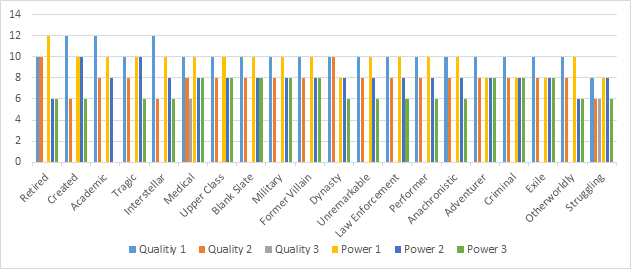
Finally got the character sheet for the Struggling character I mentioned earlier, in case anyone is interested.
Hope everyone in the USA has a great holiday weekend! Bootstrap - Full.pdf (12.4 MB)
Finally got the character sheet for the Struggling character I mentioned earlier, in case anyone is interested.
Hope everyone in the USA has a great holiday weekend! Bootstrap - Full.pdf (12.4 MB)
That looks like an awesome character.
But… to be nitpicky (and hopefully not ruin an ongoing campaign) I think there was an error.
Struggling assigned 1d8, 2d6 - Check
Power Source assigned 2d8 and 1d6 - Check
Archetype assigned 3d10 and a d6… but Robot/Cyborg says that you need to assign their extra d10 to a tech power, which would be Alien Exometal, so either Vitality, Strength, or Conviction would be a d6.
This would mean if you had Vitality as a d6, you couldn’t retcon to switch it with The Gifting Hand. You’d have to swap with something else.
I know it is nitpicky, but it jumped out at me as I was seeing how the character was built.
Nice catch!  I’ll have to check, but I believe their intent was for Conviction to be a d6. I’ll find out, though.

That is not nitpicky – that was a straight-up error that needed to be fixed!  I’m annoyed I didn’t catch it, myself…
It was just a one-shot. Some folks wanted to learn the game and were having fun making characters.
As someone who’s done a decent chunk of white-rooming and not much actual playing for the game, I want to say a quick thing that I think might help some folks bridge our differences of opinion: there is a broad difference between “this option is less effective” and “this option is useless”, and there is similarly a broad difference between “this option is more effective” and “this option is mandatory”.
In general, I prefer for options for character creation to be close in effectiveness to one another. I don’t require perfect balance, and frankly I think it’s probably impossible to get, but if you have an imbalance that’s easily adjusted, I want to know what the real benefit of that imbalance is.
There have been two core arguments against changing Struggling. The first is that the difference is not so big as to make Struggling characters useless, especially if they take the right Power Source and/or Archetype. I would agree with this argument. It is, in fact, fairly difficult to make a useless character in Sentinels unless you’re doing it pretty deliberately. On the other hand, if the adjustment is an easy one, I don’t see it as a huge deal.
The second argument is that Struggling characters should have a harder time in play, and that this is fun. I’m not sure that I agree with that argument, mainly because I think that they should be struggling narratively, not struggling during action scenes.
In general, the idea that a “struggling” character trades high dice for more dice doesn’t actually seem bad to me, it’s just that the dice they’re trading for aren’t very big, resulting in those characters ending up looking for workarounds. I could see either (a) Struggling characters still getting big powers, which would kind of match many of the ones in fiction, or (b) Struggling characters getting a lot of d8s to play with.
EDIT Also, with regards to some of the comparisons above, it’s probably worth noting that my Struggling character from that set was playing with a few extra restrictions that made them weaker than they would have been had I been starting from scratch. Because I was limiting what I had access to, I had to give them two Mobility powers, I had to combine their Struggling with a Power Source that didn’t give d10s, and I got stuck with Divided to really mess them up.
I fully agree. They aren’t worthless, they are perfectly viable as is. But I don’t see the point in them being a weaker option when they don’t have to be. And I worry about people getting caught off-guard by it using the guided method.
Heck, just realizing it might be a problem could even be enough, because then it is a buy-in. It just isn’t immediately clear that there is a discrepancy and can catch players and GMs off guard
This is precisely what I’m concerned about.
If a player choses this Background, fully aware of the mechanistic implications, and feels good about it, that’s easily the best way.
But if a player has a cool character concept in mind but feels that setup is needlessly unattractive because of being quite noticably nerfed, then that character concept is effectively discouraged for a player who still wants to feel ‘equal’ (in whatever twisted way) with their peers (which I believe is a valid demand for players to make).
It is for this case that I am seeking options.
Simply saying ‘just don’t pick that background if you don’t like being nerfed’ feels like a very disappointing way to address that player’s concern.
For me personally, it doesn’t help much that the official stance on that issue is ‘we know it’s imbalanced, and chose to be ok with it’ - because it also feels quite lackluster, leaving some players out in the cold when offering a hand would have been such an easy thing to do.
I like Slickriptide’s idea of counting die sides to evaluate mechanistic proficiency, so I went and crunched numbers based on that.
Firstly, I went and checked how many die sides each background gave. Since Qualities always default to 4, I only counted die sides “above 4”.
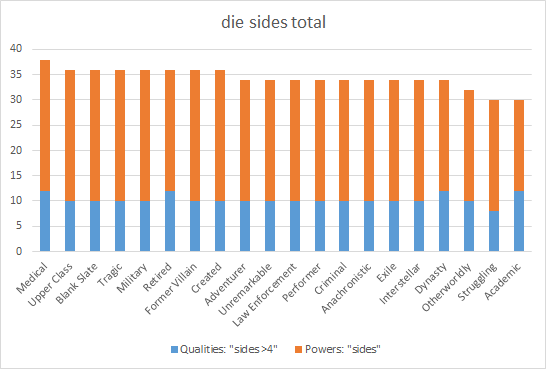
Unsurprisingly, Struggling comes last - but shares that place with Academic. But then, Academic makes up for its smaller dice by also giving a whopping god-like d12. On the other hand, Medical looks much stronger than one would expect for getting a few more pips at the lower end of the scale. So maybe the approach isn’t quite right yet.
What’s more, the mere sum of sides does not reflect how big dice weigh heavier than a spread of smaller dice. Remember that you can ususally pick your dice rather freely; and picking your d12 or picking one of your two d6s should make a tremendous difference!
However, if we consider that the moment for a Hero to be at their best is meant to be when using their Principles, and if we then also consider that the pivoting point for a successful Overcome (that is, without adding complication) is “roll 8 or better”, it might seem helpful to have a look at how much die sides of “8 or better” each background brings.
And suddenly, things look quite drastic:
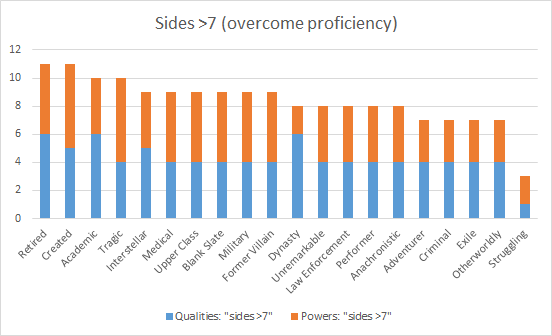
(Edit: re-uploaded to sort by size)
Anyhow, if we could get past the “should we do balancing at all” for a moment, I’d really love to hear your thoughts on how you would balance, if you were to do so, even if only for the sake of the argument.
That’s a rather clear picture of how much struggle that Struggling has. Thanks for the number crunch!
No offense, @der_andere_Jan, but the last chart (removing the d6s) is pretty biased, specifically since one of the benefits of the backgrounds with lower dice is more dice (Struggling or not), and that ignores many of those dice.  (And the justification for using it also makes an assumption that there won’t be bonuses – and there are frequently bonuses.
  )
)
I’m more interested in seeing a sum of averages, as that gives a better indications of how many dice combined with the size of those dice. If I can make time, I’ll give that a shot…
But I understand the concerns folks have and don’t see anything wrong with GTG addressing them if they want to. As I’d mentioned, it just hasn’t come up in actual game play as a actual problem that seemed like it needed to be addressed. 
Also, Twists aren’t the end of the world.
This is where it would be useful to hear from the game devs about their intentions, rather than attempting to divine those intentions intuitively.
We’re having the same discussions that they must have had between themselves when they wrote the book, yet they wrote it this way anyway. There must be a reason for it.
Yeah, but I do respect their point that there are folks who don’t play that way and/or play with a close eye on the numbers, so I don’t want to dismiss that.
None taken 
I am aware that this model is very simplistic, and only relates to how strong a background contributes to a character’s strongest suit, in the isolated situation of using a Principle to Overcome without making things worse.
Considering that Principles and their related Overcomes are the defining traits of a character, this doesn’t seem overly far-fetched. Naturally, this is still only a very small piece of what gameplay will entail! I also did not factor in how the following steps of character creation might turn things around; otherwise the math gets quite unwieldy.
It is really only an abstract statistical modelling certainly not covering every situation, but trying to measure the various backgrounds’ starting points against the gist (imho) of a Character’s proficiency, Principle-based Overcomes.
I did not include boost or twists, because they trade success for complication, in that they require spending resources at another point; this moves the imbalance around, but doesn’t negate it.
Simplification aside, I think it still nicely shows that -when it comes to Principle-based Overcomes- the Struggling background contributes very little to begin with, just to illustrate my point that from that point of view, asking for some counter-balancing might be a valid demand (which I had hoped to find inspiration for here).
By the way, another model I had toyed with was die classes, which is not too far from your idea of the sum of averages.
The math is uglier (don’t let me stop you though), but it eventuallly boils down to this:
There are four type of dice available for characters: d6, d8, d10 and d12. Let’s say d6, d8 are the lower class, and d10, d12 are the higher class.
Backgrounds give 5, sometimes 6 dice, and most provide 2 (rarely 3) of those dice in the upper class. Three provide only one in the higher class, instead offering a very constant spread of d8s and nothing below that.
Struggling now not only provides no dice at all in the upper half, it also gives half of its 6 dice at minimum size (d6)!
I would agree that in a more restrictive skill system, having or not having a skill can make a lot of difference - but in SCRPG, where stretching the narrative is the core of the game, I don’t think so much. I personally think that in a game where you can usually pick your dice freely, and where a Quality at “no die” equals a d4, one single d6 makes for a rather poor trade instead of even one single strong die.
Yes, that would be very helpful. As it stands, we do not even know whether or not they even discussed it, and neither can we fathom if the ‘reason’ is perfectly though-out and gameplay-related, or just grew upon “more important things to bother with”
Sadly, the gods chose not to reveal themselves to us (yet).
What we can do, though, is discuss what we deem appropriate houserules. 
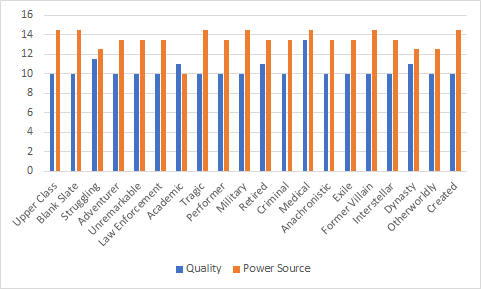
I don’t disagree with you on the numbers. But here’s the diagram I was talking about: Summing the dice averages. I think it provides a more interesting look at the overall dice available to the backgrounds. It does also show that Struggling is low on the Power Source side, but it’s actually pretty high on the quality side, which I found entertaining. 
That’s not really how I’ve experienced it, but everyone plays differently. For example, in our games players have to be able to narratively justify the use of a die, which isn’t always as easy as you might think.  Plus folks in our games rarely if ever consider using a d4 – they’ll defer to a comrade who is better at that task or come up with a different approach, instead. I honestly think I’ve only ever seen it once! But again, that’s our games.
The topic has been submitted (at least once! ) for the up-coming SC RPG podcast episode, so we’ll see if it’s picked up.
I think that’s a great idea! Please do, and I hope everyone has a great time talking through it.
Have a better one, folks!
I think the easiest house rule, if you think you need one, is to have Struggling give you a d10+d8+d6 for Power Source, instead of d8+d8+d6.
True, different folks… and I suppose every group will soon sort of fall into common habits of valuating dice pools. Seems funny to me that they should make the cut between considering it a valid option and deferring between a d4 and a d6, but then there’s nothing wrong with that either!
On the other hand, I’ve literally seen an attempt to justify flying an airplane with an Info Quality’s inherent typewriter skills (“I’m used to navigate lots of buttons, and they’re all labelled clearly anyway!”), so I guess it very much depends how silly of a stretch your group would be willing to go for.
EDIT:
It certainly looks that way. The impression goes away when you factor in that Qualities default to d4 when not explicitly given, so we must theoretically add a d4 for every Quality not mentioned - or, much easier, subtract the d4 from every Quality given.
As you have it now, the extra d6 would weigh all 6 sides (or 3.5 in average results) more than the respective d4, which isn’t accurate. (this does not apply to Powers though)
Did that actually work‽
That player was making that up as an example when introducing a new player - to emphasize the ‘dare to be bold’ notion.
In a real game situation… it would probably need to be a really, really convincing explanation. Then again, we’ve all seen cheesy plot twists in Superhero movies (what, your mother’s also named Martha? Ok then, let’s end our pointless feud!)
Maybe I’d put it to the vote of the table.
I want to throw in my 2 cents.
Overcomes have 100% chance of success without penalties being in play. That too me says that die size does not matter a lot of the time when it comes to Overcomes. Less than 8 on the effect die does result in some sort of twist, but I do not find twist to be completely bad in these circumstances. When a player gets a twist, either from an Overcome or an ability, I like to get the player’s opinion first. I’ll go ahead and use the twist if it works and is better than what I can come up with, meaning twist are as bad or good as the player makes it. I also like narrative twist more so than mechanical twist. This leads me to give a twist that will further a character’s story. If nothing is coming to mind at the time is when I will go ahead and just hand out a penalty or damage.
One example being I have a player whose character had been missing for roughly 10 years. Now their back and have yet to contact any family. A lot of his family’s wealth was spent trying to locate him and they were originally pretty well off. Using a twist one of his siblings is now a thief because they were used to a certain lifestyle. After seeing the player’s character on the news the sibling will track him down and try to use him for his own benefit.
Another character is super into being a hero and likes to check articles to see if he has been noticed. Sometimes when a minor twist shows up I like to use it to say he was accidently left out of all articles related to that event.
How bad of twist are players seeing where they have decided that they must roll an 8?