this is fantastic 
3 Likes
I don’t know if I like what he’s doing here…I don’t know if I have time to even review enough of it to form an opinion…but I’m certainly impressed by his dedication to a single project. I probably write more than this overall, but not all in just one place.
The Disavowed
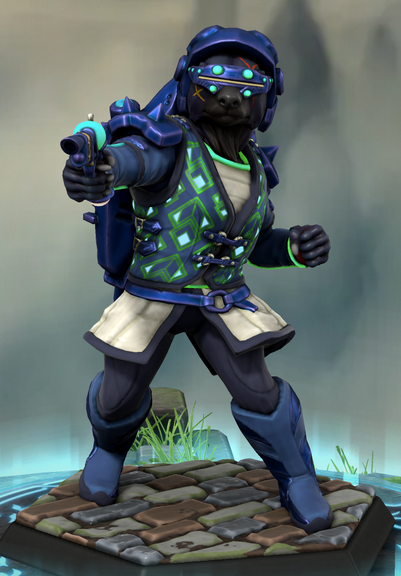
First Appearance: Vanguards (Vol. 2) #3, Sep 2022
Lieutenant Type: Enemy
Die Size: d10
Motive: Conquest, Approach: Raw Power
Traits:
- Dead Inside: The Disavowed have +2 to Attack and Hinder but -2 to all other basic actions.
- Toxic Gas: When the Disavowed fail a damage save, they Hinder all nearby targets with the result.
The new Vanguards split their time between Earthside defenses and support for the Jotari Alliance, with the team supported and funded by the United Nations and the Alliance Council. It was a dangerous time for the Alliance; as it approached the twentieth anniversary of the overthrow of the Jotari Authority, the Alliance’s member states were in discussions about whether they wanted to remain in tight alliance, shift their government into a looser commonwealth of independent nations, or dissolve completely and go their own ways. The fledgling alliance was faced by three major threats, each of which wanted it to dissolve for their own reasons: Singularity, who wished to snap up minor pocket realms on the borders of Jotari space, and whose Jotari followers wanted their old tributaries back in the fold, the Firedancers, who wanted to burn down the Alliance as revenge for spurning them with no broader plans for what came next, and the Disavowed.
Nineteen years was not long enough for an oppressed people to forget their oppressors. While the member worlds of the Alliance officially saw the Jotari commoners and rebel aristocrats as fellow victims of the old order, some of the former rebels from within those worlds disagreed. They hadn’t fought the Authority for centuries simply to turn around and hand their freedom over to more foreign aliens, whether Jotari, human, or even each other. Their vision was for each of their worlds to be truly independent, free of the stain of other cultures, and they were willing to burn down everything to accomplish their goals.
As their own governments and former allies labeled them criminals or terrorists, these rebels proudly took the name ‘Disavowed’, uniting in the goal of destroying every remnant of the old order. Each member implanted themselves with advanced cybernetics that would one day kill them, giving up any claim on a life after the Struggle ended and promising to do whatever it took to destroy the Jotari Alliance and the collaborators that they saw working within it. They would accept no compromise to their final goals – while they were willing to work with each other for now, this was only until their realms were back under their own control, at which point each member agreed that they would depart and never interfere in each others’ affairs again.
Because of this, Disavowed teams were among the deadliest threats that the Vanguards faced. To many of them, the Vanguards were a bigger threat than Singularity – she was an enemy their people could face, while the Vanguards were a corrosive symbol of unity that needed to be brought down before it tainted their lives.
Behind the Scenes:
Things are always rough in a post-revolution world. I like the idea of the Alliance being basically a decent place to live, but it’s still struggling with the aftermath of centuries of oppression, its people pulled between the enemies who don’t want to let go of their power and the people who don’t want to forgive for the sake of peace. There were a lot of compromises made when the Alliance was founded. Were they all good ideas? Maybe not, but the alternative is worse. So the fringes of rebellion unite to tear down the new world they built, because it’s not good enough. Very comic books. Lots of drama.
I’m not entirely sure where this storyline ends, but probably at a minimum it involves the Alliance getting a name change so that the Jotari aren’t symbolically on top. The Disavowed are at the extreme end of other, more reasonable opposition to the Alliance, and working with those is probably also a part of Vanguards.
4 Likes
Nasty, but also trumped by instant-kill damage (ie dealing at least twice the max current status die) since that doesn’t even allow a save so you can’t very well fail it. Awfully hard to scrape up 20+ damage in one Attack, but as they get battered down they might lose out on this triggering a time or two.
Also going to wreak havoc on nearby allies, including other Disavowed.
2 Likes
Yeah, that’s intended. Tactically, the Disavowed are encouraged to spread out so that they don’t take each other down when they die, but that means they’re less likely to get a lot of heroes in the burst of their failed saves.
2 Likes
should Mimelight have a “not the source of the damage” exception on her redirect?
could get horrible if it was down to her and one hero left standing.
3 Likes
I agree it’s nasty but it’s not unprecedented. There are at least four “full villain” reactions that can deal damage back to an Attacker, although a couple of them do have rather odd wording.
Even one-on-one you can get past it with:
- Initiative timing (unless the GM’s being an utter jerk about passing off from the scene tracker and any NPCs still standing)
- Attacks that ignore reactions (which a GM might allow as a rider on a Risky Basic Attack)
- Damage that isn’t coming from an actual Attack action (which you might be able to trigger through Overcomes to set off twists, for ex). With at best a d6 save even small amounts of environmental damage are a meaningful threat.
Anything that lets you get off an extra Attack in your turn can also breach that defense at the cost of hurting yourself with the first Attack (the most common example probably being the ever-popular Inspiring Totem Red Social ability).
Could also backfire spectacularly if you hit her with a damage type that you have damage negation or inversion for. Improved Immunity to your own damage is hilarious here.
2 Likes
“Risky action” to make un-react-able had not occurred to me, so not horrible.
3 Likes
It’s not on the official list of options, but like I said a generous GM could allow it. That list is meant to be more exemplary than restrictive, after all.
The other countermeasure to that style of reaction I’ve seen is to use minions (from the Natural power source, Minion-Maker archetype, or just using the common Red Summon ability early with a twist) to overload the defender the same way multiple Attacks do. That’s trickier if the baddie decides to redirect so as to kill another minion who hasn’t Attacked yet, though.
3 Likes
Also, Mimelight can only redirect to nearby targets, so if you’re one on one you can get some distance and whack her from outside her redirect range.
2 Likes
most of the Risky options are comparable to GREEN actions, I agree most GMs would allow it.
I always thought of it like “Power Stunts” from Marvel Superheroes RPG (TSR) where you can spend KARMA to try a new trick, but you have a fail chance until you do your new special move enough times.
3 Likes
Maximental
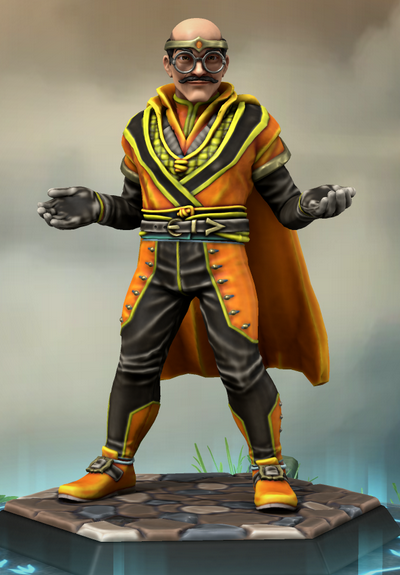
Alias: Maxwell Mathers
First Appearance: Flatfoot and Fly Boy (Vol. 2) #16, Oct 2022
Lieutenant Type: Enemy
Die Size: d12
Motive: Need, Approach: Mental
Traits:
- Tip the Dominoes: When Maximental Hinders, apply the result to any number of targets near each other. Hinder Maximental with a penalty equal to the number of targets affected.
Flatfoot and Fly Boy launched to a very different setting than the one that had been left behind. The events of Brave New World had cleared the Twin Cities of theis super-powered gangs, and while Ferristown and Ferrisville still had the usual supervillainy, Stutter had established that they were largely peaceful and free from the grip of Hank Ferris and the Company. Flatfoot and Fly Boy established that, with their home at peace, the two superheroes had spent more of their time supporting the Champions of Truth, protecting lives on a global scale.
At the same time, the world was changing. Tech companies and political forces were slowly being captured by greed and corruption in the form of a new Company led by Steeldriver and the Conductor; the married villains moved behind the scenes to try and establish themselves without alerting anyone to the risk that they posed. When Black Hat drew the attention of Fly Boy to the connection between rising rents in his neighborhood and falling wages at local factories being bought out and automated by shady tech companies, he and Flatfoot began to turn their attention back home, fighting to expose corruption and make a difference without blowing up buildings or killing executives. The duo’s enemies knew that they would be trouble, but they had ways of dealing with interfering superheroes: create villains to throw at them as distractions.
Maximental was one of those villains. Maxwell Mathers was a brilliant man at stuck in a dead-end middle management job that he hated, taking out his feelings of superiority on his employees while lacking the bootlicking skills to endear himself to his superiors. When he was fired for embezzlement thanks to an investigation by Flatfoot, the Company secretly but deliberately exposed him to strange radiations that made him able to see how all of the forces in his environment interconnected. Maxwell immediately saw how he could use his gift to get rich – but more importantly, how he could use it to make Flatfoot look like a fool.
This would quickly become his modus operandi. Maximental had overwhelming perceptive abilities (almost literally; he spent much of his time dealing with incapacitating migraines). He was able to see every fault point in an area and set off chains of seeming coincidences that did massive amounts of harm while moving himself to the place where he would be least affected. He also had a towering ego and a lifetime of repressed superiority, and nothing mattered more to him than his need to prove himself the smartest. He would take jobs with other supervillains just for a chance to take a swing at the heroes, and he would usually end up having to slip away into the night when he failed, even more bitter and certain that he would prove himself next time.
Behind the Scenes:
There’s a general idea in the Diamond Age that tech has advanced enough that it’s not that hard to create a superhuman, as long as you don’t mind devastating side effects or long-term harm to the subject. This works great for establishing demographic reasons for supervillains to significantly outnumber superheroes, so I’m rolling with it.
As for Maximental, he’s just kind of a jerk, a Riddler-level insecurity complex coupled with a willingness to hurt vast numbers of people just to make a point. And he looks like a failed math teacher. He’s also a major pain in the ass to deal with - he’s going to Hinder the team with a nasty penalty when he comes into play, and he’s hard to drop. On the flip side, that Hinder to himself could end up making the first counter-attack against him pretty hard to stop, so he could pratfall into an early out.
And he’s the last Diamond Age enemy! Next time, our final Diamond Age character, wrapping things up for this phase…
4 Likes
That one works pretty well to explain the number of weird, often-atomic monsters found in the Golden and Silver Ages. They can’t all have been accidents, right? Someone’s making those things, and you can’t really blame Doctor Demonicus for the ones from before the 1970s.
Similarly, when you get fantasy and black magic into the mix, unethical magicians are another primo source of monstrous villains.
Occurs to me that having a few minions around tasked with Boosting this guy before he triggers a mass hinder could let him avoid the worst of the side effects of this ability. Using their “Soothing Massage” and “Have A Tylenol” bonuses to offset his multitarget-induced penalty would make him quite a bit more effective while they last.
4 Likes
you could have a flunki boosting Max. Of course, his self-Hinder deleting the Boost would not help the flunki.
Question on the flunkis- many villains are accused of self-sabotage would the helpful adaptive bot try and advise against bad tactics, or would they accept that the customer expects to lose and leave backdoors open for the heroes?
3 Likes
Love the “human Rube Goldberg device” angle. Reminds me of that one X-Files that did something similar.
And seriously, a nerdy guy named Mathers? As in, somebody who maths? 
2 Likes
I don’t think the flunkis are sentient enough to support self-sabotage. They would probably register it as unexpected user error and try to develop motivational guidance to minimize it. Depending on the villain, this could result in pointing out their flaws to them and getting turned into scrap.
3 Likes
I would assume he was named for Cotton Mather.
??? There’s nothing about him that suggests “murderous witch hunter” to me. If it’s the intellectual side of things, Cotton pissed that right down the drain with his insane superstitions, and his less awful father Increase would be a better inspiration by far.
Not like Mathers is an unheard of name anyway. I had a couple in my high school class back in the day, and most folks have absorbed at least a little Leave It To Beaver through cultural osmosis.
But going FrivYeti’s previous behavior, it’s probably what fjur suggested. 
EDIT: A quick dig reveals that the surnames Mather/Mathers originated in Scotland and are derived from an Old English word for “mower” (or “reaper” if you’re trying to be edgier about it). Came to be associated with agricultural pursuits in general, so thematically related to other surnames like Gardner, Fields, and the OG on-the-nose Farmer.
3 Likes
To be honest: He has the last name Mathers because I wanted an ‘M’ name that flowed from Max, and when I thought of an angry guy whose names started with M&M my mind jumped to Marshall Mathers.
3 Likes
I can certainly follow that reasoning.
Also, I have cake today? My site anniversary, apparently.
4 Likes