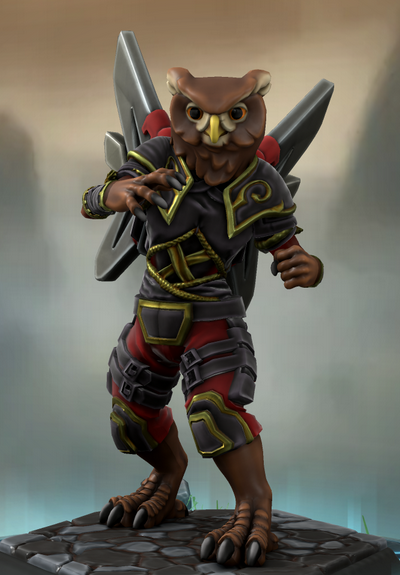
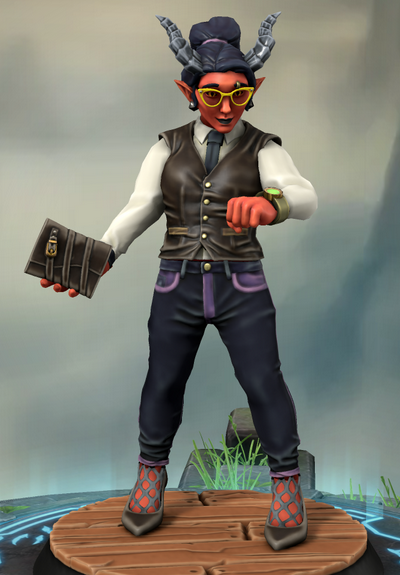
Night Bird
Alias: Birdie, First Appearance: (hero) Hidden Champions (Vol. 2) #8, Oct 2014
Background: Created, Power Source: Alien, Archetype: Flyer
Personality: Impulsive, Principles: Instinct, Stealth
Status Dice: Green d6, Yellow d8, Red d10. Health: 30 [Green 30-23, Yellow 22-12, Red 11-1]
Qualities: Close Combat d12, Stealth d10, Acrobatics d8, Alertness d6, Owl Lady d8
Powers: Flight d10, Speed d8, Awareness d8, Gadgets d8
Green Abilities:
- Screeching Strike [A]: Attack using Close Combat. Defend against all Attacks against you using your Min die until your next turn.
- Shadow on the Moon [A]: Hinder multiple targets using Flight. Apply your Min die to each of them.
- Principle of Instinct [A]: Overcome a situation that taps into your primal nature and use your Max die. You and each of your allies gain a hero point.
- Principle of Stealth [A]: Overcome to infiltrate somewhere or avoid detection and use your Max die. You and each of your allies gain a hero point.
Yellow Abilities:
- Cover The Flock [A]: Boost all nearby allies using Speed. Use your Max+Mid dice. Hinder yourself with your Min die.
Frenzy [A]: Attack up to three targets using Close Combat. Apply your Min die to each of them.
- Swoop Away [R]: When you are Attacked at close range, Defend yourself by rolling your single Speed die.
Red Abilities
- Vicious Retreat [A]: Hinder any number of close targets using Close Combat. Use your Max die. End your turn elsewhere in the scene.
- Rhybidium Plate [R]: Hinder yourself by rolling your single Gadgets die. You are immune to damage until the start of your next turn. You cannot use this ability again this scene.
Out
- The hero who goes directly after you may take 1 damage to reroll their dice pool.
Principle of Instinct (Identity Principle)
During Roleplaying: You have a set of animal instincts that help to guide your actions, giving you a primal understanding of the world that sometimes sets you at odds with modern society.
Minor Twist: What situation have you misunderstood?
Major Twist: What disaster have your instincts caused?
Principle of Instinct: Overcome a situation that taps into your primal nature and use your Max die. You and each of your allies gain a hero point.
Following the end of Earthwatch Volume 2 in 2013, Venture’s editors were already laying out plans for the next incarnation of the team. This time, the plan was laid out to introduce the new Earthwatch gradually, giving them a pair of smaller appearances to gauge the audience reaction to a new team before rolling out a formal ongoing title as part of 2016’s summer event. Cho wanted a team that would be noticeably different from the former one, and suggested to writer Terry Lang that he lean more heavily on established characters with a history of violence and struggles with their inner natures. After some consideration, Lang developed a team led by Synthesis, and made up of four existing characters and one newcome: Siphon, Twilighter, Fatale, a rogue Kel’Thoth robot that called itself Meatsuit, and Night Bird.
Night Bird had been drifting through Venture Comics for several years. She was a popular antagonist, but never quite found her footing during the Plutonium Age; after being captured and subsequently freed from AEGIS in the late 1990s, she drifted from title to title and from villain to villain, largely continuing her pattern of looking for a good scientist to serve. Lang decided to have Night Bird fixate on Synthesis, a ruthless alien scientist who regretted her earlier actions, and made the uplifted owl the heart of the team. Utterly devoted to Synthesis’s orders, Night Bird kept the rest of Earthwatch in line when they were threatening to fragment, protecting them without hesitation and building a rapport with Fatale and Twilighter in particular.
The new team debuted in Hidden Champions #8, joining Hyperstar in a battle against Hive-Minder and his robot army. From there, they starred in a limited series with three 48-page issues, Earthwatch: Shadow Force. Shadow Force saw the team facing off against SCOURGE, demonstrating their killing intent and placing them against villains that all of them agreed needed to be removed.
Earthwatch: Shadow Force was not a huge success. The characters were tilted too far towards cynicism, without a counterbalancing member to provide lighter moments. The team made a few appearances in other comics over the next few years, but Cho ended up giving the title slot that had been planned for them to Brave New World, and “Passing the Torch” spelled the end for any chance of an ongoing title for them. Siphon appeared in Brave New World, on the run from his former team, and died trying to once again bring down his old foes. When the Diamond Age began, the various members gradually appeared in different contexts: Twilighter was largely retired, Meatsuit was mentioned in Earthwatch #24 as having been a successful graduate, and Fatale would return as a mercenary working for Disaster Recovery. Night Bird herself was absent for 2019 and 2020, before joining up with Black Hat and the Codebreakers as a violent antihero, loyal and determined but without having really learned much from her time on the team.
Behind the Scenes
Night Bird is great, but she’s a villain at heart. I could imagine a redemption arc for her that took, and who knows, maybe the late Diamond Age will see someone else take a kick at the can, but for now her shot at heroism was a short one.
As for the rest of this team, I bet it was really close to working. Fatale had an almost-redemption arc in the past, Twilighter is just annoyed to be there, Meatsuit is not an interesting character and will never receive a writeup but sarcastic robot is often a winner, and Siphon is convinced that he’s already a hero and just needs everyone to recognize it.
The Principle of Instinct is a modified version of the Principle of Savagery, replacing “instinctive violence” with “instinctive missteps”. I have strong feelings about the Principle of Savagery, which I think I’ve discussed in the past, but the instinct-driven part works really, really well for her.
I also decided to make the “perfect defense” action from Technological into a reaction. I love it thematically, but it’s already only useable once per scene, and it applies a penalty, and it doesn’t come with a way to redirect damage towards you. Making it also take up your action felt like it was a bit much unless a player is doing something ridiculous like combining it with Push The Limits and a reaction that redirects attacks to you.