The History of Venture Comics!

Governor Trake

Real Name: Trake ur-Assel, First Appearance: (as Governor) Celestial Travels, July 1995

Lieutenant Type: Enemy
Die Size: d10
Motive: Conquest, Approach: Raw Power

Traits:

  • Radioactive: When Trake Attacks or Hinders using radiation, he rerolls any 1s.
  • Fall Back: When Trake fails a damage save, he treats his result as a Defend until the start of his next action.

The Uranian Dominion had a rough time of it during the Iron Age. As part of his work collapsing the galactic order, Ernest Mallory had triggered an attempted coup against Overlord Trake, collapsing the Dominion into two dozen warring states that were unable to unite to take advantage of the fall of Xur’Tan. In the early 90s, Harris Marvin wrote a storyline in which the warring states were briefly brought together under the rule of Exarch Suret as the Uranian Empire, united by a war with the Jotari Authority, but the Empire’s failure to defeat the Jotari caused it to fracture again.

When Lina Ingram took over Celestial Travels in late 1995 and began to lay the groundwork for the Grand Galactic Summit, one of her goals was to refine the Uranians into a force that was a threat, but not a resurgent empire. She left them broken into three warring factions – the remaining Uranian Empire, still under Exarch Suret, the Bountiful Dominion, a theocracy controlled by Neutrino’s old foe Confessor Yira, and the Uranian Confederacy, an alliance of seven ‘governors’ claiming equal authority over their people. The former Overlord Trake resurfaced as one of these Governors, used as a symbol to draw old Uranian loyalists away from the Exarch and give the Confederacy a claim to being the true inheritor of the Dominion. Trake seethed about being reduced to one of seven rulers, but it was a far sight better than his previous role as a minor warlord exiled from his home.

As one of the Governors, Trake was a fairly minor player throughout the late 1990s. He was still a scheming bully, prone to fleeing the moment that things turned against him, but he tended to appear as a secondary antagonist to whichever Governor the Celestial Travellers were being forced to deal with. He attended the Grand Galactic Summit and was nearly killed by Incursion, he fought against the Travellers on the fringes of the newly-established Union, and he spent quite a bit of time on Earth with his old allies in the Congress of Deceit, bemoaning his fall from power, but he didn’t have any major plots of his own.

As for the threefold Uranian powers, they lasted for much of the 1990s, until the Governors grew too successful for their own good. Exarch Suret was killed after being manipulated into attacking the Earth, and Trake convinced Confessor Yira to join his side again, returning him to prominence in the early 2000s. A lack of foes caused the Governors to turn on each other, leading to another four years of civil war before Trake was able to manipulate the situation into the formation of the Uranian Free League.

Behind the Scenes:

Another villain sliding into the background for a few years before they get their feet back under them. This happens periodically to alien warlords; they lose their power base and have to rebuild. We know that it takes Trake a while to fully re-assert himself, since his re-appearance in 2004 is a big deal; I suspect that while he’s back to villain status instead of being a second fiddle by the end of the 90s, he doesn’t actually do much for five years or so. There’s too much else going on.

I really like his mechanics, though. He doesn’t get full bonuses, but his mastery of nuclear power is reflected by never getting a 1, and his defensive reaction helps to keep multiple heroes from piling on him without doing anything to actually protect him in the moment.
4 Likes

Cometfall

Real Name: Jehmaa Harkur, First Appearance: Stargazers #40, October 1995

Lieutenant Type: Ally
Die Size: d12
Relation: Family Member, Approach: Physical

Traits:

  • Meteor Smash: When Cometfall Attacks, she may Attack or Defend a second nearby target using half of her result (round up).
  • Unreliable: Whenever Cometfall rolls a 1 while taking a basic action, an allied hero must take a minor twist.

In late 1995, Jim Lowe was told by Fiona Terrace that she wanted Hyperstar to leave Stargazers and move over to the Champions of Truth next year. Stargazers was still successful, and Terrace gave Lowe the option of continuing the title as a Zeitgeist solo or bringing in other underutilized Venture heroes to expand the premise, but he needed to lay the groundwork for Hyperstar’s departure. Lowe jumped on the opportunity to claim the Drifter, a hero he’d always enjoyed, and he decided to round out with the Penitent for an interesting opposing viewpoint, but deciding how to prepare Hyperstar for the move was a thornier problem. After some consideration, Cometfall was his solution.

Cometfall first appeared in Stargazers #40, an alien mercenary on the run from clients she had defrauded, who crashed on Earth with her enemies in hot pursuit and demanded that Hyperstar help her. She revealed that she was Ash’lyy’s older sister Jehmaa, born with the same mutations as Hyperstar, and that rather than becoming a con artist, she’d become a one-woman mercenary unit that fought for minor skirmishers across the galaxy. Much like Ash’lyy had been, Jehmaa wasn’t cruel, but she was a little bit too greedy and a little bit too cowardly. She had abandoned a job when it became dangerous, only for her employers to win the war and send assassins after her to convince other mercenaries not to do the same.

Ash’lyy agreed to help, but only if Jehmaa stayed on Earth and learned to become a hero. Cometfall reluctantly accepted, joining Hyperstar and Zeitgeist on their travels. She was a deeply mixed benefit, throwing herself into combat without proper caution, occasionally endangering innocents by mistake, taking advantage of chaos to grab unattended goods or just running away when things got too sticky. She and Ash’lyy had a series of angry confrontations, in which Jehmaa accused her sister of abandoning her to play hero on a backwater, and Ash’lyy blamed Jehmaa for teaching her all the wrong lessons and manipulating her into a life of crime as a child.

In the end, however, the sisters made up. Ash’lyy finally accepted her own responsibility for her past crimes and recognized how much she had grown, and Jehmaa admitted her own role in Ash’lyy’s criminal past and acknowledged that her sister had truly become a better person. After six issues, Jehmaa turned herself in to the authorities chasing her to save Ash’lyy from danger, promising that she would work to turn her own life around.

Cometfall didn’t make many appearances after her initial run. Writers would occasionally note that she was still in communication with Hyperstar, and she appeared every once in a while in a Celestial Travels story. But the storyline itself was one that had its share of fans, and helped smooth the transition of Hyperstar to the Champions of Truth.

Behind the Scenes:

Secret sibling! It’s a comic staple, and here’s one of them.

This was definitely a wild retcon when it came out; Hyperstar had been around for fifteen years, and had definitely had various backstory bits that did not suggest she had any kind of active family. But it was fun, so here it was! And then Cometfall was more interesting as a one-story element than a long-term foil, so she vanished, and every so often someone said “oh yeah, Hyperstar has a sister, doesn’t she?”

It’s possible she’s a deep cut member of one of the Celestial Travels teams in the Diamond Age, but not one that actually shows up much on screen or gets many lines.

Mechanically, she amuses me, because she is an absolute beast except that every so often she completely ruins your team’s plans.

3 Likes

And the more worn down she gets, the more frequently she screws up, so she’ll tend to be more of a problem as a scene progresses.

1 Like

Very true, although it’s also plausible that she will cut and run once she drops to a d8, which makes her mechanics support her characterization!

And speaking of characterization and mechanics literally affecting each other, let’s look at…

Big Brain

Real Name: Anton Petrov, First Appearance: (dimensional) Covert Tactics (Vol. 3) #156, Dec 1997
Background: Former Villain, Power Source: Multiverse, Archetype: Modular (Robot/Cyborg)
Personality: Distant, Principles: Split, Gearhead

Status Dice: Green d10, Yellow d8, Red d8. Health: 28 [Green 28-22, Yellow 21-11, Red 10-1]
Qualities: Technology d10, Alertness d8, Science d8, Otherworldly Mythos d6, A Brain In A Robotic Shell d8
Powers: Shapeshifting d12, Lightning Calculator d10, Robotics d8, Strength d6, Speed d6

Green Abilities:

  • Alternate Reality [A]: Boost yourself using Shapeshifting. Then change modes.
  • Principle of the Split [A]: Overcome a situation that benefits from having a completely new outlook and use your Max die. You and each of your allies gain a hero point.
  • Principle of the Gearhead [A]: Overcome a technological challenge and use your Max die. You and each of your allies gain a hero point.

Green Modes:
Brain In A Jar:
Lightning Calculator d10, Robotics d6

The Hero: Shapeshifting d12, Lightning Calculator d12, Robotics d10, Speed d8. You may not Attack or Hinder.

  • Self-Upgrade [A]: Boost yourself using Lightning Calculator. Create one bonus using your Max die and one bonus using your Mid die. These bonuses are persistent and exclusive.

Yellow Abilities:

  • Sacrifice Reality [A]: Destroy one bonus on you. Change modes, then take an action in the new mode.
  • Deploy Restraints [A]: Hinder multiple targets using Shapeshifting. Use your Mid die for one and your Min die for the rest.
  • Shock Field [R]: When you are hit with an Attack at close range, the attacker also takes damage equal to their effect die.

The Scientist: Shapeshifting d12, Lightning Calculator d12, Robotics d10, Speed d8. You may not Attack or Defend

  • Situational Analysis [A]: Hinder or use one of your Principles to Overcome using Lightning Calculator. Use your Max+Min dice.

The Villain: Shapeshifting d12, Robotics d10, Lightning Calculator d8, Strength d8. You may not Boost, Defend, or Overcome.

  • Unleash The Drones [A]: Attack one target using Robotics. Attack a different target with your Min die. At the end of your turn, you may change modes.

Red Abilities

  • Break Reality [R]: When you are hit with an Attack, you may change to any mode. If you do, take extra damage equal to the Min die or take a minor twist.
  • Overlapping Voices [ I ]: At the start of your turn, swap two of your power dice. They stay swapped until changed again or the scene ends.
  • Countermeasures [A]: Remove a bonus on a target. Hinder that target using Technology. Use your Max die, and that penalty is persistent and exclusive.

The Bulwark: Shapeshifting d12, Lightning Calculator d10, Strength d8, Speed d8. You cannot Attack.

  • Ablative Defense [R]: When you are Attacked, you may Defend against the Attack by rolling your single Shapeshifting die. If you reduce the damage to 0 or less, you may also Hinder the source of the damage with the result of the die you rolled.

Out

  • Boost an ally by rolling your single Red status die.

After sending Shatterpoint into the void during his assault on Covert Tactics, each member of the team was affected differently. Madame Liberty and Kid Liberty largely reclaimed their past capabilities, broadening them slightly with their additional knowledge. Irogane reclaimed her heritage, finding a better balance in her world. But Big Brain was much more intensely affected.

Big Brain’s body was a robotic construct designed around his mental waves, which he could upgrade and modify at will. Having two timelines worth of history in his head put a significant strain on that construct, leaving him with a deep case of dysphoria and confusion, and the remnants of the Sovereign’s power left him with even more memories of timelines that might have been, the dream worlds that he had lived through and could not forget. His memories became jumbled, shifting rapidly between modes, and his body adjusted itself to match, trying to create a stable environment for the hero to operate in. Sometimes, Big Brain would be the former Soviet revolutionary. Sometimes he was the scientist that Madame Liberty had saved, or the hero that had joined her in the 80s. Occasionally he was the villain trying to unleash his puppet robots, although even then he retained enough control to not be an active liability – usually.

As he tried to navigate and integrate his memories, Big Brain stumbled onto the methodology that AEGIS had used to manipulate him in the past, and determined how that could be extended into mind control. His unique perspective allowed him to recognize that this was what had happened to the Vanguards and a handful of other former heroes under AEGIS control, and he led the alliance with the Champions of Truth to save them and begin the process of shutting AEGIS down for good.

This confusion and collapse was unsustainable, of course, and the writers of Covert Tactics knew it. Bit by bit, Big Brain was able to excise the fragments of memories that he didn’t need any more, storing them on specially-created data drives as he built himself back to the person that he wanted to be. By 1999, the rapidly-cycling hero was back to his stable self, and his personality glitches were a thing of the past – and surely, nothing would ever come of them…

Behind the Scenes

I am reminded of why I don’t build Modular characters often. This takes up enough page space that the actual storyline is fairly short, but honestly that works for this story, because Big Brain’s storyline here is indeed fairly short.

Mechanically, Modular is always weird, but if you back-build your Power Source choices based on your modes you can get something decently interesting. In Green, Big Brain Boosts himself and slides into his hero mode, then builds a couple of big Boosts he can use to his benefit. He can then either move slowly in Yellow, or rapidly shift into a new mode to create major Hinders or to Overcome serious problems, or to unleash Attacks rapid-fire and then shift to a less aggressive mode. In Red he can burn through his Boosts to hop back and forth between villain mode and defensive mode, getting some strong hits in and then falling back on a significant defense.

Narratively, those pieces of Big Brain’s old villain personality definitely have to appear again, but I don’t actually know where yet! TBD, I suppose.

5 Likes

Why do I feel like I know the name Anton Petrov

1 Like

There are a number of real Anton Petrovs out there; it’s a common-enough name that I rolled with it anyway. Some of them are athletes, one of them is a science Youtuber. Maybe you’ve run across that?

(Or it could just be from Big Brain existing up-thread, but the latter seems more likely.)

4 Likes

You and me both. Gad, I hate this archetype. So overcomplex for so little payoff. And all because Bunker has mode cards. First thing on the chopping block if there’s ever a new edition and I have any input on it at all.

That’s a pretty great powerless form, and bonus points for being unable to access Alternate Reality due to having no Shapeshifting to use with it. At least you could still get out of it on your own with Sacrifice Reality or Break Reality and suitable narrative justification, but it might take a while to set up. Seems appropriate, even as a disembodied brain you really don’t want to leave this guy unwatched for very long or he’ll restructure existence to free himself eventually.

That should be do IIRC.

2 Likes

I’m assuming the science Youtuber is also the Canadian math teacher who has a minor planet named after him, which is neat. 660931 Antonpetronov isn’t quite up there with 77185 Cherryh in terms of fame, but it is probably quite a lot bigger given that the author’s tributary rock is only about 4km wide.

2 Likes

Fatale

Real Name: Isabella Black, First Appearance: Vanguards of Hope #1, April 1999

Lieutenant Type: Ally
Die Size: d8
Relation: Reluctant Ally, Approach: Raw Power

Traits:

  • Draining Touch: When Fatale Hinders with her touch, she Boosts herself with the same result.
  • Aura of Weakness: Fatale’s allies have +1 to Attack and Hinder.

After being freed from AEGIS control in 1998, the Vanguards returned to the pages of Venture Comics in April 1999 with the five-issue Vanguards of Hope miniseries, written by veteran Jim Lowe and drawn by 90s stalwart Bob Kavka. The primary storyline of Vanguards of Hope saw the Vanguards reunite with Partisan as they fought to stop the latest Director Hades of AEGIS, who had joined forces with the Jotari Authority to try to staunch the damage done to the organization by the heroes working against it. In the first issue, AEGIS struck by attempting to assassinate Partisan before he could meet with his old team, only to be saved by an unlikely ally – Fatale!

The government assassin was on the run, looking for someone who could protect her from her former allies and develop a new stock of the medicines that kept her alive before she ran out. Having learned that the Vanguards had been freed from AEGIS control, Isabella saw a route to freedom for herself, and she was determined to take it. The Vanguards were suspicious, but Fatale explained that in her whole life, she had been forced to work for people she despised in order to survive – first with Guardian, and then with AEGIS. She truly wanted to be free, and she truly wanted to make AEGIS suffer for blackmailing her for years and forcing her to kill.

Captain Bolt decided to take a chance on Fatale, and much of the plot of Vanguards of Hope had a running theme of uncertainty about whether he’d made the right call. Several pages of the comics implied that she was playing the long game, still in communication with Director Hades and preparing to bring down the Vanguards from within, while others showed her bonding with Neucleon and revealing details about her past to Captain Bolt. In the final issue of the miniseries, it turned out that Fatale had been trapping AEGIS, not the Vanguards. She’d let Director Hades believe that she was infiltrating the team, but had done it to lure him into the trap that would let the heroes destroy him.

Lowe knew that a new Earthwatch was in development, and had hoped for Fatale’s inclusion in Vanguards of Hope to lead to her joining the team as a reformed villain. Unfortunately, the writers of Earthwatch had other reformed villains in mind, and Fatale slipped under the radar after her redemption, occasionally appearing as a bodyguard or dubiously moral agent in Company Town, narrowly evading becoming part of SCOURGE, and ultimately becoming a villain again in the rebooted Covert Tactics in 2003. But some of her characterization from the miniseries endured; she was far less prone to killing now that she was free of her masters’ shackles, avoiding harming civilians and only taking contracts against people who were already part of the criminal underworld she’d slipped back into. She briefly appeared as a member of the short-lived 2015 incarnation of Earthwatch, and then reverted to criminality again.

Behind the Scenes:

This one was a bit ironic because I got halfway through it, realized that I was soft-launching Earthwatch, and then quickly needed an explanation for why that didn’t happen. I think “it was a different author” is probably good enough, honestly!

Fatale is interesting because she’s one of the ‘major’ villains who didn’t really go anywhere in my designs. She was a Rogue Agents villain, and then I noted that she joined AEGIS under duress, but I had no idea what happened to her as AEGIS got whittled down in the late 90s, and I had no notes for her at all throughout the Plutonium Age. So when the time came to use a deep cut to touch on the Vanguards of Hope miniseries, she seemed like the right person for the job.

Mechanically, she’s a great help to the heroes, but she’s a little bit squishy so she’s going to need to stack up some Boosts to give herself damage save bonuses.

And that’s the last of our Iron Age fill-ins! We’re moving on to the Plutonium Age next, as we trundle towards the end of this phase of the project.

4 Likes

Helpful enough to merit some defensive reaction support from the PCs, too. Heroes can’t really heal lieutenants, but some of their team Boost abilities can give her some help too - I forget which ones are worded “ally” and which are limited to “heroes” though.

1 Like

Kynetic

Real Name: Joe Samson, First Appearance: (villain) Company Town #171, April 2003
Approach: Generalist, Archetype: Indomitable
Upgrade: Group Fighter, Mastery: Mercenary

Status Dice: Always d8. Health: 25+5H
Qualities: Acrobatics d10, Imposing d8, Criminal Underworld d6, Cyborg Soldier d8
Powers: Swinging d10, Gadgets d8, Awareness d8, Vitality d6

Abilities:

  • Armor Plated [ I ]: Reduce physical and energy damage dealt to you by 1 if the scene is in the Green zone, 2 in the Yellow zone, or 3 in the Red zone.
  • Internal Armory [A]: Boost using Gadgets. Use your Max die. Defend with your Mid die.
  • Quick Fighter [A]: Attack multiple targets using Acrobatics. Hinder those targets using your Min die.
  • Swingline [A]: Attack using Swinging. Either Hinder that target using your Max die, or Defend yourself with your Min die and you and that target end up elsewhere in the scene.
  • Cold Protector [R]: When an ally is Attacked, Defend them by rolling your single Awareness die. Boost yourself by that amount.
  • (U) Ultimate Soldier: When you take an action that lets you make an Attack, also make an Attack using your Mid die.
  • (U) Master Mercenary: If you have been given a contract to perform a specific task, automatically succeed at an Overcome in a situation where the difference is getting paid and not getting paid.

Common Scene Elements:

  • A less physical Villain that Kynetic is acting as a bodyguard for.
  • A group of minions belonging to another villain that Kynetic is leading on a smash and grab.
  • A shadowy warehouse: An environment filled with suspicious goods and dubious security systems that attack heroes and villains alike.

An ongoing storyline for Kynetic throughout the 1990s was the nature of his past life. During the fall of Guardian, Kynetic was offered the opportunity to recover his old memories, but he was forced to choose his current life and partners instead, allowing his memories to be deleted as he destroyed Guardian’s mainframe to save Matrixx’s life. The writers at the time had decided that this was the end of the story; Kynetic’s had found a new home with the Rogue Agents.

Of course, comics being comics, that was never going to last. In Company Town #169, during an otherwise-routine operation against the Outfit, Kynetic was momentarily overcome by a flashback to an operation in a war-torn city. Overwhelmed by his memories, he accidentally killed one of the Outfit’s members. In the aftermath, Kynetic temporarily put himself on standby while he tried to figure out what had happened, and whether it would put others at risk.

In Company Town #171, Matrixx offered to delve into Kynetic’s systems, looking for the memories that were locked within. Kynetic agreed, and the duo found the damaged partitions that had been previously hidden deep in his subconscious. When they hacked them open, Kynetic’s old memories as ‘Joe Samson’ came rushing back to him. It turned out that the reason that Joe had been unfindable was that he was a black ops agent for AEGIS, a deniable asset whose entire life had been wiped clean in order to allow him to operate as the organization’s Agent Ares. A ruthless and remorseless killer, Joe eventually became greedy, doing wetwork on the side. When he was caught, rather than executing him AEGIS chose to put him through Guardian’s new super-soldier program, locking his memories down to keep him loyal.

When the blocks on his memories gave in, however, Joe Samson rushed to the fore, overwhelming Kynetic’s more recent memories. Confused and disoriented, he broke out of the Rogue Agents’ base, fleeing into the night. Remembering only that he was a rogue on the run from AEGIS, with fragmented shards of his more recent time hovering in the background, he immediately returned to his old ways, operating as a mercenary, bodyguard, and hitman as needed for the criminal underworld. Violent and cynical, Joe believed that he couldn’t rely on anyone, and that the world was eat or be eaten. He took on increasingly dangerous jobs, playing the various criminal factions of Ferristown against each other as he took on missions for the highest bidder. His employer one issue would be his target in the next, and while he mainly focused on theft and protection, he was more than willing to take on an assassination or two.

In his new mode, Kynetic became a consistent opponent to the Rogue Agents. It became quickly clear that while he didn’t overtly remember them, there was some part of him that didn’t want to hurt them; given an opportunity to kill Matrixx early in Company Town #175, Kynetic shocked himself by backing down and fleeing instead. He became obsessed with his lost memories, ironically becoming a mirror of his old self as he tried to figure out what had happened to him since his conversion. There was no strong storyline planned for this; the writer simply thought it was interesting, and left the door open for it to become permanent or to be resolved however people wanted. And at first, it was popular, but after a year of villainy fans began to mutter about the loss of their hero. In Company Town #200, Matrixx found a way to reactivate Kynetic’s memories, restoring his personal growth. The cyborg returned to the Rogue Agents, recalibrating himself and coming to terms with being made into a vicious weapon once again; the aftermath stuck with him for the next several years as he struggled to ensure that he would never become Joe Samson again.

Behind the Scenes

This is one of those storylines that people probably mostly pretend didn’t happen. Kynetic got forcibly reverted to a pre-personal growth state, became a villain again, and then was restored to his previous self.

Probably some people were pretty unhappy with him becoming a killer, others wanted him to stay a killer, and still others just thought it was a neat storyline and were glad it was done within three years.

5 Likes

Count me in that camp. : D

2 Likes

Same. And at least it resolved the questions about who he’d been before his first heroic phase, so that’s a plus.

Heartily approve. The world needs more villains who make Swinging a key power. I did my part with Crossbolt way back when, but there’s always room for more.

1 Like

Yeah, swinging is a fun power that doesn’t get used as much because it’s so specific. And since I removed the other swinging hero, gotta give Kynetic some props. And speaking of props…

Flatfoot

Real Name: James Lawson, First Appearance: (hacker) Champions of Truth #430, April 2006
Background: Created, Power Source: Tech Upgrades, Archetype: Gadgeteer
Personality: Analytical, Principles: Hero, Hacker

Status Dice: Green d10, Yellow d8, Red d8. Health: 28 [Green 28-22, Yellow 21-11, Red 10-1]
Qualities: Technology d12, Investigation d8, Close Combat d6, Digital Brain d8
Powers: Gadgets d10, Lightning Calculator d10, Awareness d8, Remote Viewing d8, Strength d6

Green Abilities:

  • Precise Strike [A]: Attack a target using Lightning Calculator. Hinder that target with your Min die.
  • Neural Overload [A]: Hinder using Gadgets. Use your Max die, or use your Mid die and make it persistent and exclusive.
  • Tactical Decisions [A]: Boost using Lightning Calculator. Make one bonus for one ally using your Mid die and another for another ally using your Min die.
  • Principle of the Hero [A]: Overcome in a situation in which innocent people are in immediate danger and use your Max die. You and each of your allies gain a hero point.
  • Principle of the Hacker [A]: Overcome by using your digital network and use your Max die. You and each of your allies gain a hero point.

Yellow Abilities:

  • Shock Rounds [A]: Attack multiple targets using Gadgets, using your Min die against each.
  • Override [A]: Change any bonus into a penalty of equal size or vice versa.
  • Relentless [R]: When Attacked, treat the amount of damage you take as a Boost action for yourself.

Red Abilities

  • Technological Integration [ I ]: When taking any action using Technology, you may reroll your Min die before determining effects.
  • Hijack Systems [A]: Select a technological minion. That minion is now entirely under your control and acts at the start of your turn. If you are incapacitated, you lose control of this minion. You may also choose to release control of this minion at any time. At the end of the scene, this minion is defeated.

Out

  • Remove a bonus or penalty of your choice.

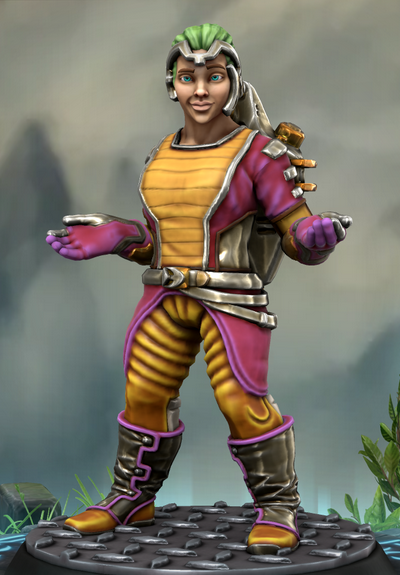
By 2006, a new tension was forming between the supporters of classic superheroes, the remnants of the dark and gritty 90s, and the business-minded attitudes of the new editors installed by editor-in-chief Zack Murphy. Under Murphy’s tenure, most of the longstanding stalwarts of the line began to see their presence slip. Liberty’s Dream was cancelled, with Madame Liberty and Reverie rolled into what Murphy saw as the more ‘marketable’ Dark Rivers. Flatfoot and Greenheart began to slip from Company Town and Cryptic Trails, the titles that they were theoretically headlining. Murphy oversaw the ‘death of Dawn Rider’ arc that ended Twilight Carnival, and pushed Protean out of high school and into college so that he could pitch a TV show about her that never really took off.

Lina Ingram, who had moved to Champions of Truth following her successful run on Celestial Travels, initially resisted Murphy’s changes, doing her best to keep the title as the four-color throwback that she believed fans were more interested in, keeping storylines simple in order to facilitate the growing number of company-wide crossovers taking place, and shifting around to focus on each of the team’s members. However, she saw which way the wind was blowing. Murphy was making particularly grumpy noises about Flatfoot and Wonderer, both of whom he saw as outdated Silver Age nonsense badly in need of a reboot. In the hopes of appeasing her editor in chief, Ingram put together a new storyline for Flatfoot that she believed would bring him into the digital age.

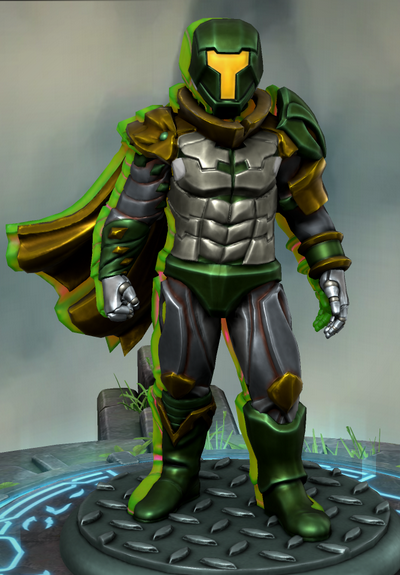
As an ancient robot, Flatfoot required periodic updates in order to remain active and functional. In Champion of Truth #430, with his parts beginning to fail once again, he called on a team made up of his old assistant Colin Harper, his friend Fly Boy, and his newer ally Matrixx to implement a series of upgrades that would last him for the next few decades. These upgrades added digital layering to Flatfoot’s existing wireframe brain, giving him direct wireless access to surveillance systems and digital networks. With it, he could hack into security systems, overload weapons, or even take control of robots, power suits, and cybernetic enhancements.

Ingram’s updates were ultimately a failure. Fans weren’t particularly interested in the robot detective becoming more of a technological wild card, they wanted to see him wading into combat alongside Greenheart and using his keen eye to solve crimes. His new capabilities also wound up stepping on the toes of Fly Boy, leaving the team’s previous mechanical genius with less to do, while making it harder to include him against magical foes or those who used raw power to assault their enemies. Ingram began to put together a plan to streamline the new upgrades, striking a balance that would move Flatfoot back to the front lines while retaining his digital mind and hacking abilities, but before she had the chance Murphy announced his own plan – replacing the Champions of Truth with a new generation of heroes, the Champions of Tomorrow. The decision spelled the end of Ingram’s time on the title, as Murphy had his own choice of writer picked out for the new team.

When the Champions of Tomorrow failed and Flatfoot recovered his capabilities, the new writers took advantage of the shift to quietly erase his digital upgrades, having the Rogue Agents rebuild him using older parts and restore him to his previous functionality. The only long-term effect of his time as a hacker was that it directly modified the capabilities of his successor, giving Netizen incredible hacking abilities rather than just robot limbs.

Behind the Scenes

Nothing too exciting here; just laying some groundwork for why Netizen behaves the way he does, and giving us a bad idea for the last of the Big Four of Venture Comics - we haven’t had a bad version of Flatfoot yet, so we get the weird hacker robot.

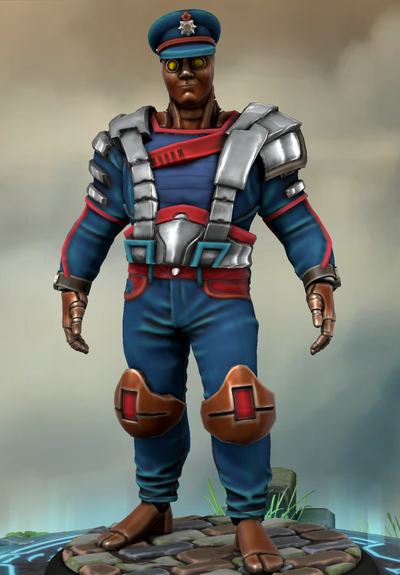
I was able to use kitbashing to make his hat a bit smaller, though! So win there.

6 Likes

Decades of time misspent on playing Games Workshop minis games when I was younger have left me with an inescapable belief that the larger and more grandiose your hat is, the more powerful you are. The multi-tiered hats found in Jack Vance’s Dying Earth have probably contributed considerably to that.

Having a “bad Flatfoot reboot” story where his hat gets smaller seems perfectly in keeping with that.

Glad he reverted to his previous self (and hopefully hat size) afterward. If there’s one thing real life should have taught us, it’s that any machine that can function without being “connected” should continue to work that way. Barring literal physics-defying superpowers you can’t hack something that thinks “the Cloud” refers to local weather phenomena and the internet is a series of tubes.

2 Likes

I’ll read the post later, but my first impression based on the look is “is that Flatfoot Dredd!?”

Edit - ok not really

2 Likes

I definitely see it! I think Flatfoot Dredd was probably was the evil mirror Flatfoot looked like.

1 Like

all these alt character sheets is making me think of Avengers Forever. We had circus era Hawkeye, modern Wasp, and Giant man, Yellowjacket (a 2nd delusional Hank) future Songbird and Genus Vell… and a younger Cap. Then Cap showed off super, super strength and all his friends realized that this was a depressed and disillusioned Steve who had just watched a high-ranking American politician commit suicide when revealed as leader of the Secret Empire.

2 Likes

For whatever reason, almost all my childhood reading involving Hank Pym (which was admittedly quite limited) had him as Yellowjacket (and apparently happily married to the Wasp), and none of the stories ever dwelt on his other superhero IDs so I was pretty clueless about his past and his origins. If it wasn’t for Marvel Premiere origin of Scott Lang’s Ant-Man I’m not sure I’d even have known Pym was connected to the character.

To me, Hank’s always going to be the Yellowjacket that showed up in those two issues of Marvel Team-Up where he and Janet and Peter are fighting Equinox and it feels really weird when people refer to the character as delusional, troubled, an abusive spouse, etc., etc. I just know I liked his character design and the idea of two dinky insect-themed energy-blaster heroes, and teh drama was an unwelcome surprise when I did finally learn of it. First impression matter a lot at a young age, and that just wasn’t how they were writing him back in that brief window where he was back in the Yellowjacket suit.

Of course, Equinox also turned out to be nothing like his original MTU appearance in #23, and might not even be the same character - maybe the one I know is the original’s son or something? OG Equinox was clearly an adult and older than the heroes, whereas “my” Equinox was a troubled kid with somewhat out-of-control powers. Internet claims otherwise, but the writers sure didn’t pitch him that way.

Maybe Marvel was suffering from timeline bleed back then and accidentally published some of non-616 stories without realizing it? :slight_smile:

3 Likes

Given situations like that, I would most generally prefer to have an alternate universe or psychic landscape or something, where it is revealed that every person has that kind of darkness within them, but they wouldn’t be a hero if they didn’t staunchly refuse to actually do that. So Hank would never actually strike his wife, but we’d know he’s capable of doing so.