Eh, it is Sunday night. They’ll catch it eventually.
Is “mods” even a plural at this point?
Eh, it is Sunday night. They’ll catch it eventually.
Is “mods” even a plural at this point?
Christopher, Paul, and Pydro are all still around, albeit not frequently. Technically, Christopher and Paul are Admins, but they can serve as Mods when needed.
I don’t expect any of them to be working on a Sunday night, really. 
Hey Rich, if I were to GM the SCRPG, would you play?
No.
Okay. Someone else? Friv if he’s done here, which I suspect he’s not? Fjur maybe?
Yeah, I am rather too busy for it. Maybe you should try the Sentinels reddit? I think they had an LFG section for a while.
In the meantime:
Agent Weathers
Real Name: Leslie Weathers, First Appearance: Covert Tactics (Vol. 2) #2, April 1962
Lieutenant Type: Ally
Die Size: d8
Relation: Romantic, Approach: Technological
Traits:
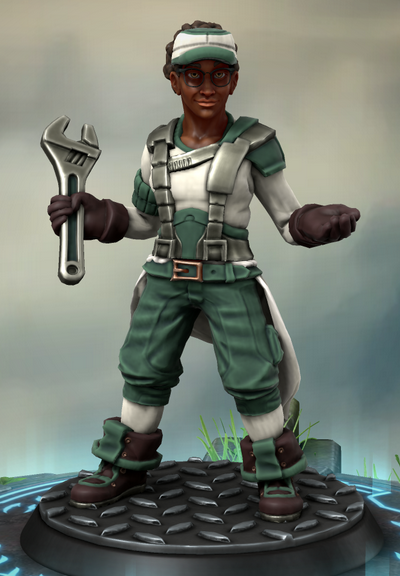
When Covert Tactics re-launched in 1962, it wasn’t entirely clear how the team was going to operate. Edwin Sherman had envisioned his team as working out of a military base, with a full support squad, and after spending the first issue introducing the heroes on an action-packed mission, he used the second issue to briefly introduce a handful of the characters that would be backing them up. One of the foremost of these was Leslie Weathers, who was developed as both the team’s mechanic and as a romantic foil for Kid Liberty.
Leslie Weathers was born in New York, and worked as a mechanic in a local garage. A mechanical prodigy, Weathers happened to be on hand when Kid Liberty was dealing with a Soviet infiltrator who was blowing up buses, and her quick thinking saved a cross-town commute from becoming a bloodbath. The U.S. military was impressed by Weathers’ quick thinking and mechanical skills, and she was quickly recruited to work on a local army base. In turn, Kid Liberty spotted her name on lists of potential support staff and reached out to her, offering her a job. As support personnel, she would report to base staff rather than to him, but her main duties would be upkeep and upgrades to Covert Tactics’ gear. Leslie was intrigued and agreed, but not without teasing Abe that there were easier ways to ask a girl out on a date.
Unfortunately for Leslie, Joe Manzetta hadn’t envisioned Covert Tactics as having a large support contingent. The team was supposed to be small, highly mobile, and always active on location, and what Sherman and Manzetta quickly found was that it wasn’t possible to balance the nature of the missions they wanted to write with the sort of supporting team that was already growing over at Vanguards! The Covert Tactics base began to be de-emphasized in early 1963, and supporting team members were quickly shuffled offstage. In-universe, Sherman made a quick recognition of this fact, retconning the support team as having been temporary agents on assignment from their respective militaries.
Because of her romantic connection to Kid Liberty, Leslie lasted longer than most. She pivoted to becoming an unofficial military liaison, helping the team with their gear on an unofficial basis and taking part in an ongoing will-they-won’t-they relationship with Abe. But readers found Leslie’s romance with Kid Liberty entirely too reminiscent of Madame Liberty and Rick Wilson, and she never quite found a solid place in the narrative. She ended up taking an active deployment in 1966 and largely leaving the strip; in late 1971, she died in the field in Vietnam in a highly controversial storyline about the cost of war. Abe mourned her loss, and aside from a brief appearance in the Night of Lost Souls event, that was her final impact on Venture Comics.
Behind the Scenes:
One thing I’ve been thinking of for these deep cuts is that I want to shift up the balances; this book is going to have fifteen failed supporting cast and only ten failed villainous lieutenants, because failed villainous lieutenants are harder to lay out without them just being villains. But there are always a lot of attempts to add people to a comic’s supporting cast, and most of them don’t go anywhere useful. Leslie Weathers ends up as one of those, and doesn’t end up making a big splash. She probably shows up occasionally in reboots and adaptations.
That’s a neat ability. Always been mildly annoyed that so few PC abilities interact much with the environment. If I were doing a new edition of a GYRO Supers game that would be on my short list of things to add more of to the system.
Thinking about it, that’s a neat one too. Really encourages the players to throw some Boost support her way, because they’ll get paid back threefold with a little luck. She’s only a d8 and improving the odds of her achieving a +2 or +3 is pretty easy even with a run-of-the-mill +2 assist.
Once her die degrades that’s a lot less attractive, but having a bonus in place in first place might extend the period where she can crank out triple Boosts, even if they won’t directly benefit from a bonus used on a save. Really, really good target for a persistent bonus, but those are rare as hen’s teeth when it comes to applying them to allies. Taking a twist for an extra use when boosting her might pay off though. On the flip side, if she’s going out in a blaze of glory anyway, she could twist herself to Out from a d4 to drop two-use bonuses on three heroes at once - and if she rolls a 4, they’ll even be +2 rather than +1.
Thanks! Yeah, I like how her setup pays off. She’s a very helpful support in a couple of ways, but she’s fragile enough that just getting in the spread of a villain’s AOE is likely to create some trouble for her.
I would love to, but unfort. I think I’m in the same boat as Friv: I’m just too busy with obligations &c. and don’t have enough time in most days for that to really be feasible. Sorry.
That being said, in addition to what Friv said, I think there’re some other places around the 'Net that you could look if you wanted to find players:
And if, for one reason or another, one wouldn’t wish to actually play on any of those platforms, one could perhaps recruit players there and then run the actual game elsewhere on the Web. (This might be against RPG.net’s rules? I’m not sure.)
If you do try to start a game, good luck!
There’s only one game running there at the moment, inspired by the recently-released Dispatch PC game. It’s full up (and quite large) with eight active players and multiple people on the reserves list in case of dropouts. I wouldn’t expect any openings for quite a while, if ever. So far it’s going pretty smoothly, and the GM has my respect for being willing to tackle trying to run multiple teams/scenes at once. We’ll see if the holiday season works its usual disruptive magic or not soon but the format seems pretty resilient.
Interest in PbP SCRPG is generally pretty high over there, with GMs being the sticking point as usual. Worth keeping an eye on the posts here to see new games recruiting and players calling for GMs.
I think it’s okay at RPG.net, although I’m not sure which sub-forum you’d need to post to. Have to ask a mod about that before starting a casting call.
The Huntsman (II)
Real Name: Calum Mallory, First Appearance: Skybreaker Stories #50, July 1962
Approach: Underpowered, Archetype: Overlord
Upgrade: Hardier Minions, Mastery: Mercenary
Status Dice: 9+ Minions: d12, 5-9 Minions: d10, 3-4 Minions: d8. 1-2 Minions: d6. 0 minions: d4.
Health: 25+5H [Upgraded 30+5H]
Qualities: Close Combat d10, Imposing d8, Alertness d6, Throw Money At It d8
Powers: Robotics d8, Electro-Whip d6, Awareness d6, Vitality d6
Abilities:
Common Scene Elements:
When Glenn Cochrane created the Silver Age Skybreaker, working closely with artist Ronald Tackett, the two couldn’t quite agree on what to do about the question of the mysterious enemy seeking Skybreaker’s spear. Cochrane had included the plot beat almost as a throwaway, just created to give Skybreaker an easy source of danger in his first issue. He had no ideas about who might want the spear, and he had even less interest in following up. Tackett, on the other hand, felt that having introduced the problem, the duo had to continue working on it. He imagined the mysterious villain seeking the spear to be a major source of opponents for Skybreaker, and pushed Cochrane to write a storyline introducing Locksmith as the first of these enemies. When Locksmith proved highly popular and Cochrane wasn’t interested in replacing him, Tackett let the matter rest for a little bit before bringing it up again as the series approached its fiftieth issue.
Cochrane was finally worn down, and slapped together a villain to appease his increasingly-frustrated artist. Following the tradition of Skybreaker foes like Mary Molotov, he made this villain one who used some of the style and trappings of a Golden Age enemy, but who was entirely unrelated.
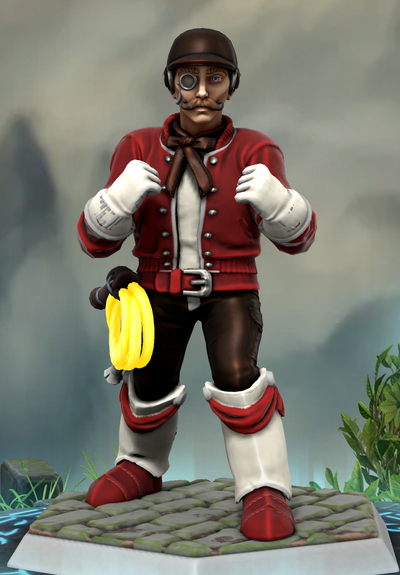
Calum Mallory was an upper-class man with few ambitions beyond a life of luxury, and whose family could trace their lineage back to the Mayflower and before. As his family funds ran down, the aristocrat invested in an arsenal of robots shaped like animals, and went into business as a professional mercenary and bounty hunter, operating mostly on the shady side of the law. When he received a commission to acquire the spear of Skybreaker from the mysterious Mr. Dark, who was tired of Locksmith’s failed attempts to acquire it, he immediately donned his hunting coat and began to pursue Skybreaker through the streets of Grovedale. When Skybreaker defeated him, too, he became filled with rage, and began trying to work with anyone who would pay him for his revenge.
The new Huntsman had a warped sense of fair play, always announcing his presence in advance and allowing his prey to leave if they could best whatever targets he had put before them, but also using armies of foes to harry and weaken them before he struck. Alone, he was no match for Skybreaker even with his electro-whip, but with a pack of robot hounds, an electronic steed, and his Hired Hunters, he was a sizeable threat to the beleaguered demigod, especially if he joined forces with another villain in an attempt to claim the spear.
For all that, however, the Huntsman wasn’t one of the more popular foes in Skybreaker’s arsenal, and Cochrane had some resentment at having had to make him in the first place. He made a few appearances over the next three years, but when Cochrane and Tackett’s relationship blew up in 1964 and Tackett angrily quit Venture Comics entirely, Cochrane took the opportunity to entirely dump the storyline and the character, letting the entire plot thread lapse and making it known that he would rather no one else pick the character up either. When Harold Mossby became editor-in-chief a few years later he allowed Cochrane to tie the whole affair off with a bow, ‘revealing’ that the Huntsman had been Mr. Dark the entire time in 1966 (despite it clearly not making sense based on either character’s earlier appearances) and having the Locksmith blow him up. When the original Huntsman returned in the early 70s, it mostly closed the book on the possibility of this one being revived, and Knightgrave would revive and refine the concept in the creation of X-Calibre, fully removing any chance of the Huntsman’s return.
Behind the Scenes
I legitimately love looking up some supervillain and discovering that there were actually five of them, none of them connected in any way even though they all fought the same hero, so that’s what I’ve done here. There was a Huntsman in the Silver Age, and he was not very well-liked and also kind of silly, and then he died and no one cared.
This story also lets me do a bit of a Lee/Ditko situation with Cochrane and Tackett, which is also doing the Venture version of “Who is the Green Goblin”. The difference here is that no one cared about Mr. Dark and he had no confrontations with Skybreaker and in fact Skybreaker never even really knew that he existed and then he got blown up and the whole thing took nine years.
It was not a good storyline.
Interesting variant on Overlord’s usual summons trick. Much less annoying and swingy too, since the minion dies sizes aren’t tied to villain status and can’t easily cascade into huge numbers of d12 lackeys if the heroes get behind on their sweeping. Plus you don’t have to deal with the full range of minion sizes from d4 to d12.
That’s a strong upgrade for the right villain. What kind of Health bonus does it come with, if any?
I feel like this goof ought to announce his presence with distant hunting horns and the baying of robo-hounds. Also maybe have some kind of nemesis rules when dealing with fox-themed heroes/rival villains?
Yeah, I’ve been playing around with house rules for that trick, and this one is my preferred adjustment. I’ve been using it for most of the Venture minion-making villains.
A mere +5. It’s the Venture houseruled version of Hardier Minions, giving a one-time boost as an inherent rather than repeated boosting as an action.
Seems like you’re on the right track with both. Minion creation for villains is one of those subjects that probably needed to be tweaked in a hypothetical revised/second edition rulebook, but that doesn’t seem likely to happen at this stage.
I’ve started doing it in my head already
Pinstripe
Real Name: Barnaby Bennett, First Appearance: Champions of Truth #25, February 1965
Lieutenant Type: Ally
Die Size: d6
Relation: Mentor Figure, Approach: Social
Traits:
As Joe Manzetta’s tenure as editor-in-chief of Venture Comics became increasingly inconsistent over the course of 1964 and 1965, he began to embark on a series of ‘suggestions’, often offered on a whim, which he believed would bolster sales or bring in new readers. While a few of these suggestions bore fruit, such as his insistence in turning Faith Evans into Nucleon, most of them ended up more like Pinstripe.
Manzetta was convinced that the Champions of Truth needed a butler. When it was pointed out that the Champions of Truth didn’t even have a base, Manzetta waved the objection away and said that Wonderer could summon the butler with magic the same way that he summoned the heroes. That way, someone could have their uniforms ready for them if they were called up unexpectedly, and could offer moral support and handle first aid and the like. With Glenn Cochrane retired, there wasn’t anyone left in the company willing to say no to him, and so Barnaby Bennett was introduced to the pages of Champions of Truth #25 in early 1965.
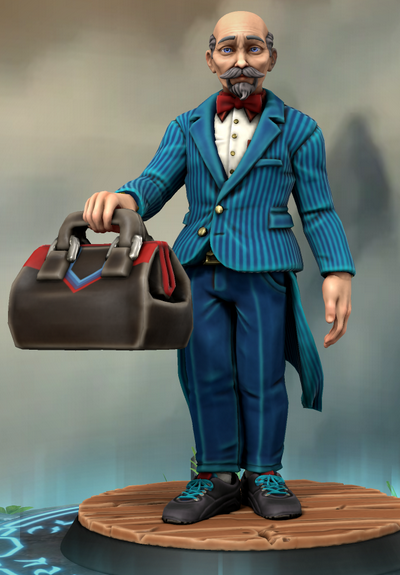
Barnaby was an older man, a firm believer in the Champions of Truth who was called by Wonderer’s magic after a particularly rough fight. He quickly sized up the situation, got the team to safety in his old car, and patched up their wounds, sewing their costumes back together and encouraging them with stories of their own grand adventures. Why surely, he reasoned, this latest foe wouldn’t stand a chance! Buoyed by his faith in them, the Champions returned to the fray and won their second round, and soon Barnaby was being summoned before most of the team’s outings, offering wisdom from his life experiences and carrying spare costumes around for the team to change into. He even gave himself a superhero alias – Pinstripe – to prevent a villain from finding him where he lived.
The whole premise was slightly ridiculous even for the Silver Age, Pinstripe never received any characterization beyond “obedient fan and wise mentor”, and none of the authors assigned to work on Champions of Truth particularly cared for the bit. When Manzetta stepped down in 1966, Pinstripe’s appearances began to decline. He only appeared a few times each in 1967 and 1968, and when the Head Master emerged in 1969 he tricked Pinstripe into revealing key information that was used against the Champions. In the aftermath, Pinstripe chose to retire, realizing that while he still supporting the Champions of Truth, his time as a hero’s assistant was done. He would make a few more minor appearances over the proceeding decades, none of which were more than glorified cameos by the few writers that remembered the odd man fondly.
Behind the Scenes:
Speaking of ridiculous supporting cast members: How about a butler who does not have a headquarters to buttle in?
I thought of going all-out and having Pinstripe be revealed to have been the Head Master the whole time, but I ultimately passed on it for meta reasons. Right after the Head Master’s attack, Wonderer starts shifting to a policy of using his magic to randomly call up whoever’s needed, and I think that’s harder to justify to fans if doing that had just called up your greatest foe in disguise who used your own magic to infiltrate you for months. So instead Pinstripe just gets used as an information source, which makes the Head Master impressive for tracking him down instead of making Wonderer look like a fool.
Barnaby’s special rules are a little complicated, but I think I like how they shake out. People can take hits for him; it uses his reaction instead of theirs, so you aren’t going to have a lot of people doing it in a round and someone who does it can still Defend or counter-attack. He literally hands out costumes and then you have to run and find a place to change to Boost and heal and be ready to fight again. He’s good at Boosting, sort of, but his die is so low he’s not that good at Boosting. Overall, I like the spread.
Seems more like a valet than a butler, in the same way Jeeves doesn’t really act as a butler for Bertie Wooster very often. I suppose when you have no silver to polish, no butler’s pantry, and no subordinate servants to manage keeping everyone looking their best becomes the priority.
Isn’t he, though? Barring penalties, he’s 50/50 to generate a +2 or +3. That’s better than a d10 would generate. Even very small dice are impressive when the end result is bumped up by one.
Probably going to want to pop this ASAP before Bennett meets with an unfortunate accident (or two, since it works just as well at d4 as d6), since the challenge can just sit there until the PC needs it.
The fact that it uses the target’s status die has some interesting interactions with various arrays. Probably don’t want to use it in Green so the 10/8/6 heroes are less likely to get their d10, but finishing it in Red feels like you would get more out of your regular abilities, so all those people with d10 or d12 probably don’t gain much either - unless they can use Inspiring Totem to trigger it with a “free” basic Overcome. If it usually gets finished in Yellow, the oddball personalities with d6 rather than d8 are slightly handicapped. And you’re always risking a twist as your costume change goes awry somehow, so trying to get a Principle in play seems important.
Getting seen/photographed mid-change seems like a very appropriate twist here, whether it endangers a secret ID or winds up in a “topless She-Hulk” style story.
That is a very clever mechanic. I could see using it with other allied characters where keeping them alive is vital. Have to point this one out to the gent who’s running our Dispatch-inspired PbP game.
A villainous (or even neutral) lieutenant who can do a reaction to redirect an Attack to a hero without their voluntary cooperation would be very mean. Maybe such a thing would merit giving that hero a bonus to smacking the tricky little weasel using them as human shield.
Yeah, that is a good point. Valets get called butlers quite often even though it’s not correct and I have a bad habit of doing that as well.
Mm, that’s a good point. Maybe I should just give him a +2 to Boost, so that he’s usually creating a +2 bonus with a small chance of +1 or +3.