The History of Venture Comics!

You could go either way and I don’t think anything breaks. There’s only the one of him, his die is very small, and even with his reaction he won’t last long if the baddies want him gone.

I suspect the only people who actually care much about the responsibilities of a butler are actual butlers, but I might be wrong. Wodehouse pretty much established Jeeves as the archetype for most folks, and Bertie’s household (such as it is) doesn’t really call for the kind of staff commonly associated with having a true butler.

1 Like

A normal update tomorrow, but today, some random stats!

I very belatedly thought that I should take a quick look at the powers that I’ve been giving people, to spot where there are holes in my setting once I move past the deep cuts and back into major things. There’s some time to spare; the events aren’t going to use them much, so it’s really not until we hit the orgs. But it’s not a quick process!

I’m now through the first volume (Gold and Silver Ages) tracking d12s, d10s, and d8s (d6s seemed small enough not to bother) and I have learned a few things about my character creation instincts!

  1. There are a bunch of powers that no hero or villain has at d12 or d10: Cold, Intuition, Stone, Water, Part Detachment, Postcognition, Remote Viewing, Leaping, Swimming, Swinging, Wall-Crawling, and Signature Vehicle. On the other hand, there are only four powers that no hero or villain has at d8 or above, and they’re mostly mobility-based: Stone, Leaping, Swimming, and Swinging. But no stone-supers! That surprises me a bit. I know I have a couple coming up as I do more Animate stuff, of course.

  2. I’m not surprised that I usually give characters, especially heroes, Intellectual powers. I was surprised that the powers I gave them were mostly Presence (18) and Awareness (17), rather than Deduction (7), Lightning Calculator (4), or especially Intuition (4) which I would have guessed a lot of folks would have.

  3. Similarly, I’m not surprised to see a lot of physical traits, but I am surprised that apparently I didn’t much care for Speed at this point, with only three characters having it at d8 or above and one at d10. By comparison, there are 13 characters with Strength d8 or above, 11 with Agility, and 8 with Vitality.

  4. Venture is definitely much more Marvel than DC when it comes to flight! Of thirty heroes, only six can fly, and two of those fly at d6. Notably, none of the Champions of Truth fly at this stage.

Curious to see how the balances shift when I finish tracking the Bronze and Iron ages.

5 Likes

Is there a specific reason you kept going to a 10/9 ratio of heroes to villains? It seems oddly specific, and contrary to the population of SC, since while there are more heroes than solo villains, there are way more Nemesis targets and Environment villains and so forth than there are heroes if any variety.

Anyway, I absolutely love the idea of Flatfoot. I’m super happy to see some positive representation for cops, and as someone who’s really tired of evil robot tropes, I’m really pleased with the idea that someone builds a robot to be the perfect crimestopper, and nothing goes wrong, he’s just superhumanly good at fighting crime and protecting non-criminals.

The ratio actually changed later on (30 heroes, 35 villains was the final setup) but yes, there was a reason initially!

The reason was that the hero character creation pieces are all in sets of 20, whereas there were 18 villain approaches and 14 villain archetypes. I was going for even sets, so I added four archetypes to bring the number of villains up to 18 and then just halved it on both sides. That left ten heroes and nine villains to get all of the options a roughly even amount.

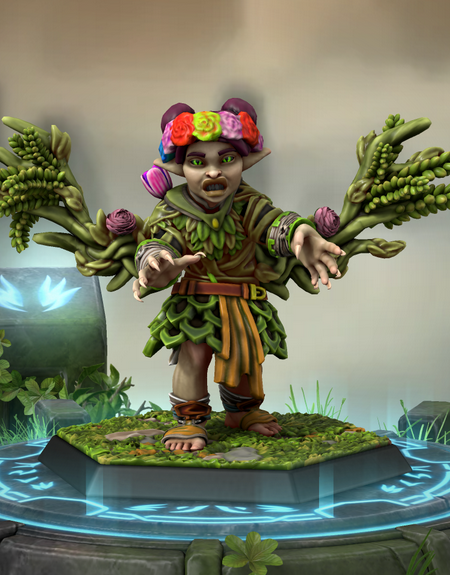
Petal Pixies

Real Name: Something unbearably twee, First Appearance: Wondrous Adventures #65, July 1967

Lieutenant Type: Enemy
Die Size: d8
Motive: Destruction, Approach: Magical

Traits:

  • Garden Mites: Petal pixies have +2 to Attack or Hinder as long as there is plenty of nearby foliage for them to dart in and out of.
  • Vanish: When a petal pixie succeeds at a damage save, they can’t be targeted again until they take an action. A hero may make an Overcome action to locate a hidden pixie and allow all heroes to target them.

As the 1960s wore on, Wondrous Adventures found itself in an unusual place. While other superhero comics were moving increasingly towards serial plots and higher stakes, the title was firmly ensconced in adventures of the month. Slightly over half of its issues continued to feature Wonderer as the lead, with the Drifter would appear two or three times a year, and another two or three issues a year featuring minor heroes like Gold Guardian or Splendor. In an attempt to bring some consistency to the line, Harold Mossby suggested an ongoing plotline to take place over a year from mid-1967 to mid-1968. It would include Wonderer as its lead, but side characters would also become involved in the overarching plot, and while each issue would be readable as a standalone there would be a throughline of a particular threat to keep readers interested. The writers who worked on Wondrous Adventures were game, but unfortunately their brainstorming session was accompanied by several bottles of bourbon and a truly brutal smog outbreak, resulting in the creation of the petal pixies.

First introduced in Wondrous Adventures #65, petal pixies were not fae despite their name. Rather, they were once-innocent nature spirits living in the parks of Ferrisville who were corrupted by pollution, gradually becoming twisted and violent. In order to protect their beloved plants, the petal pixies decided that they needed to destroy all of Ferrisville’s industry and machinery and kill anyone who tried to stop them. They began with subtle sabotage, wrecking a new factory that was preparing to open, and Wonderer intervened to save the lives of the foreman and workers. Over the next several issues, the petal pixies struck through a variety of plots and schemes, tricking other supervillains into helping them with their goal and gradually escalating their operations until they finally attempted to drown all the humans of Ferrisville and render the area pristine to nature once again.

In the end, Wonderer was able to use his magic to purge the corruption from the petal pixies, restoring their childlike natures and returning them to the woods, and he pledged to help protect the wildlands of Ferrisville from industrialization, a pledge that no other writer ever bothered to follow up with. The petal pixies themselves had been an interesting enough idea, but the writers were never really able to balance their whimsy and danger and the storyline was considered a bit of a flop. The little nature spirits would appear again from time to time, twisted by some new pollution, but they were largely forgotten by the broader Venture Comics community.

Behind the Scenes:

I knew I wanted a Wondrous Adventures monster lieutenant, but I didn’t have any strong ideas. Some futzing around with randomizers gave me “enemies that are plant and inivisibility-based”, and that gave birth to this idea of pollution-tainted flower spirits that dart out of the undergrowth and claw you up while cackling maniaclly. It’s not a particularly original idea, but these are deep cuts, not common foes.

Kitbashing comes to victory again - I spent rather longer than I would prefer to admit working on the wood-and-plant wings for these pixies. They’re actually built out of a bow, with various plant pieces stuck onto them.

5 Likes

Alcohol and air pollution are not an ideal mix for connecting with one’s Muse, I suppose. :slight_smile:

Making good use of that membership upgrade, I see.

My personal proclivity for physical kitbashing has me mulling over how I’d about a similar project. I’ve got some old Fairy Meat miniatures that might do as a basis, and there are several small sets of evil fairies out there if they wouldn’t. Making them woodwings would be pretty simple, I’ve hot plenty of leaf-and-flower pieces from various terrain projects and craft store sales in Ye Olde Bits Boxxe. Which reminds me, I really need to arrange a good home for all this modelling stuff when I die. The three people I’d planned to leave my stuff to have all gone and pre-deceased me, the old adage about gamers being immortal as long as they have unpainted minis having proven sadly untrue. The few other minis enthusiasts I’ve kept up with online live too far away to make a post-mortem pickup practical.

Minor stylistic suggestion if this ever gets published:

Slightly more natural-sounding that way, and avoids repeating “two or three issues a year” in such close proximity while retaining the gist of the sentence.

2 Likes

“incredibly twee” lol

Ah, I remember Fairy Meat. Not with any fondness, just the be using fact it exists.

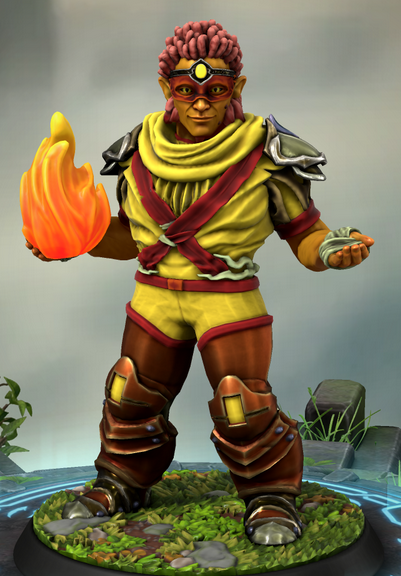
Brightforge

Real Name: Duncan Forger, First Appearance: Liberty’s Dream #69, Dec 1969

Lieutenant Type: Ally
Die Size: d10
Relation: Frenemy, Approach: Raw Power

Traits:

  • Forgehammer: When Brightforge Boosts another character, he may either Attack a nearby target with a value equal to the bonus created, or gain a bonus of the same size as the bonus created to his next damage save.

As the Silver Age began to shift and change in the aftermath of Dimensional Devastation and Venture’s new leadership, every comic line found itself lightly experimenting with new ideas and concepts. In the case of Liberty’s Dream, one such experiment began in 1969 with the slow transition of the Animate Townships from individual locations that the Animaster would create and then immediately abandon into an increasingly thriving patchwork of communities scattered throughout the Underhill, neighboring both Earth and fae societies and learning from both. This new nation required a new approach for Reverie; she couldn’t just march in and overthrow Animaster when he had actual guards and armies. It also meant new characters, and one of the most initially promising but quickly forgotten was Brightforge.

Aden Forger was a high-ranking loyalist in New Anima, the capitol of Animaster’s growing nation. Born of fire, he crafted both weapons and luxuries for the small but growing Animate nobility, and his crafts earned him similar luxuries from his fellows. From his creation, however, Aden was troubled by the strict hierarchies that the Animaster enforced. He crafted himself a costume and went to explore the other townships, quickly discovering how brutal his master’s rule was and vowing to work to fix it. As Brightforge, he raided weapon shipments, melting them down and turning them into tools to benefit the common Animates, and liberated food shipments from warehouses to feed the starving.

Reverie encountered Brightforge during one of her attempts to stop Animaster from conquering a small fae enclave. Any hopes that she had of the Animate hero becoming a fellow revolutionary, however, were quashed. Brightforge pointed out that his people were dependent on the Animaster for new children, and that he couldn’t be so simply overthrown. While Brightforge fought to help people, he saw Remedy as a foreign interloper with no care for what her interventions might inflict on the people who suffered the most. He was willing to quietly help her curb the Animaster’s amibitions of conquest, but he would not seek revolution. Instead, he hoped to continue to sabotage the Animaster, weakening his rule until his people could assert themselves and force him to step down and turn over the secret of their creation.

Unfortunately, while Brightforge was a popular character at first, the limits that had been placed on him by this philosophy meant that he wasn’t a commonly-occurring one. To make things worse, by the early 1970s Reverie’s writers had shifted to focusing on the fae and integrating her into the return of the Fomorians, allowing Animaster to fall by the wayside for several years. In the process, Brightforge largely vanished; he would make a few occasional appearances once Alchymia returned, but never became a core part of her supporting cast.

Behind the Scenes:

I don’t have a lot of notes about what Animaster is up to in the 1970s, even though he is overall one of Reverie’s main opponents. It made sense that he faded for a bit when the Fomorians became the Big Thing, and this character got created to buff that storyline up.

Brightforge is definitely a low-key Vietnam critique, creating a situation in which even if the bad guy is worth overthrowing you don’t necessarily want to come in swinging. But that’s not very superheroic, so when we get back to Anima it’s full of a lot more large-scale revolution and cool fights and his core conflict isn’t really brought up (in fact, I think by the 90s the Animates just know how to make more of themselves and the core conflict straight up doesn’t exist.)

And that’s in for the Silver Age! We’re roaring ahead into the Bronze Age next, with a few Bronze Age people slated to go up before my winter break. I’d sort of hoped I might align the break with the end of ages, but things did not quite work out that way.
2 Likes

It seems strangely appropriate that the Animates would quietly figure out the “facts of life” sometime in the Bronze Age and the whole thing was a given by the fan-service-filled Nineties. The Comics Code was steadily losing its deathgrip on censoring even vaguely adult material throughout the time period and writers didn’t need to dance around the subject so much anymore. Not actually much outrage left by 1984, as this article reminds us.

I have 2 of the issues named in the article.
Death of Korrey’s H.I.V.E. BF includes the Captain Carrot preview leading to issue one of Zoo Crew.
Issue with Dick taking of the costume and Terra making a joke is a random issue I have,

Now I am picturing a story where a group of Animate academics needing to observe two humans have sex and the comedy of how the heroes arrange that.

1 Like