The History of Venture Comics!

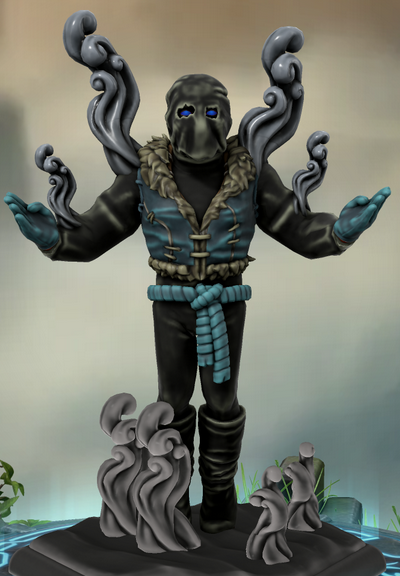
Mr. Murk

Real Name: Fabian Banks, First Appearance: Into the Green #98, April 1971
Approach: Ninja, Archetype: Domain
Upgrade: Calming Aura, Mastery: Malice

Status Dice: Based on environment minions, lieutenants, and/or challenges. 3+: d10. 1-2: d8. None: d6. Health: 50+5H [Upgraded 60+5H]
Qualities: Stealth d10, Imposing d10, Acrobatics d8, Close Combat d8, Thief of Joy d8
Powers: Fog d10, Flight d10, Awareness d8, Remote Viewing d8, Vitality d6

Abilities:

  • Living Nightmare (I): Ignore damage from environment sources during the environment’s turn.
  • Into the Mists [A]: Attack using Stealth and use your Max die. Defend against all Attacks against you with your Mid die until the start of your next turn.
  • Foggy Fiend [A]: Attack multiple nearby targets using Acrobatics. Then, end up wherever you want in the scene.
  • Sabotage [A]: Activate one of the environment’s twists in its current zone or one zone closer to red.
  • Feast on Terror [A]: Roll any number of environment minion dice and Recover that much Health. Remove those minions.
  • (U) Fearsome Fog (I): The heroes act as being in the Green zone for status die, access to abilities, and for the purposes of all abilities. Heroes may remove this ability with three Overcome successes. If a hero takes a minor twist, you may use a reaction to Hinder them by rolling your single Fog die.
  • (U) Master of Malice (I): When you take an action to demonstrate or indulge in cruelty, automatically succeed at an Overcome to inflict pain or fear.

Common Scene Elements:

  • The Malefactors: A group of four lieutenants made up of:
    • Princess Skorni (d12) [Venture History: The Classic Years pg. 101]
    • Red Minotaur (d10) [Venture History: The Classic Years pg. 140]
    • Gasser (d8). After Gasser takes a basic action, he and up to four allies may move anywhere in the current scene.
    • Brainpower (d8). When Brainpower Hinders using her psychic shocks, she also Boosts an ally with the same result.
  • Foggy Streets: A confusing environment filled with Hinders, challenges representing civilians getting in danger, and opportunistic looters and paranoid police.

In 1971, after several failed attempts to defeat the superheroes of Grovedale and Neulyon, the Malefactors found themselves in the middle of an internal struggle. The Malefactors had recently dwindled to four members after two of their former comrades had abandoned them, leaving the team made up of Princess Skorni and Mr. Murk, along with the hot rod villain Gasser, who had a near-mystical attunement with his souped-up battle car, and Brainpower, a psychic who could channel thought waves through electricity to drain them from her enemies and pass them to her allies.

Mr. Murk’s powers had been growing steadily as he practised and refined them, and he decided that he was tired of Princess Skorni’s failed leadership and blatantly direct plots. Challenging her for control of the Malefactors, he handily beat the alien princess, using his fog to confuse and disorient her before wrapping her in her own webbing. With Skorni agreeing to follow him, Mr. Murk hired perennial jobber the Red Minotaur to bring the team back up to five members and put together a plan to throw Grovedale into an endless night, bringing fear to the people and riches to the Malefactors!

The two-part Night Falls On Grovedale storyline saw the Malefactors spread through the city as Mr. Murk’s fog filled the streets, expanding far past his traditional capabilities. Able to sense anything happening anywhere within his fog, Mr. Murk moved through the city like a phantom, stealing people’s more prized possessions and spreading fear in his wake as his allies smashed up banks and stores and created dangers to distract the city’s heroes. In the end, of course, his plan failed; Greenheart was able to use her network of animal allies to track Mr. Murk down and knock him out, ending the dark fog. But before she could take him in, Gasser appeared out of nowhere, carrying the villain to safety.

The newly-empowered Mr. Murk would appear three more times in the early 1970s, each time with a grand plan to use darkness and fog to spread confusion and terror while his Malefactors went to work. Ultimately, however, writers decided that it was a little much. The benefit of the Malefactors as a team was that the group of them would go toe to toe with a couple of heroes, and the sheer scale of Mr. Murk’s new powers left him far too great a threat for that purpose. In his second appearance he was arrested, only to be broken out of jail by Red Minotaur in his third, and in a Dark Rivers appearance in 1974, writer Tony Geisman decided that Murk’s increased powers were the result of Fomorian influence and the rise of Atlantis, slowly transforming him into a corrupted monster. Veilwalker was able to purge the Fomorian taint from him, returning him to his original power level, and Princess Skorni quickly took advantage of the situation to re-assert control over her team.

While the few years in which Mr. Murk was a significant threat were mostly a footnote in Venture Comics history, they did lead to a shift in the power dynamic between Princess Skorni and Mr. Murk. In future appearances, Princess Skorni was more willing to listen to Mr. Murk’s tactical advice, making her team slightly more effective – but she was also less willing to rely on him or show vulnerability. She knew that he wouldn’t openly betray her, but that if she was too weak he might try to seize control again. For his part, Mr. Murk was done with leadership, but he deliberately used that impression to push Princess Skorni to act when she might otherwise have chosen to run. Sometimes this helped the Malefactors win minor battles, but other times it resulted in the team’s capture when they should have cut and run.

Behind the Scenes

You’ve got to have those occasional storylines where a minor villain gets upgraded to a truly dubious degree and becomes a primary threat, and Mr. Murk was too much fun not to use as the one here. (There may be one or two more in the future.) And one advantage of calling this volume Deep Cuts instead of D-Listers is that I can do it, have it be a short timeline, and just be part of his development.

It’s also a chance to write up a couple more lieutenants and stealth-deploy them. I think Gasser is probably not one of the common Malefactors; he shows up occasionally. Brainpower is a much more steady member. The Malefactors are a bit like the Sinister Six; they have a mostly-stable membership, but individuals shift in and out depending on what’s going on. Red Minotaur probably doesn’t stick around long past the end of Mr. Murk’s arc; usually, Skorni prefers to be the muscle herself.

As for this writeup - lieutenant-version Mr. Murk can create challenges, and his villain version upgrades to full-on environment control. His “Fog” power is a limited version of Weather, and I’ve done a bit of kitbashing to really amp up the fog he creates while giving him a grimmer, slightly more ridiculous outfit. I think he also goes back to the classic look later, although this one gets pulled out every once in a while.
4 Likes

I’m weirdly reminded of notorious Marvel PSA villain the Asthma Monster, complete with his Allergen Gang followers.

The leaking-smoke kitbash works nicely there. Much better than Lord Marmaduke Ffogg and his stupid pipe.

2 Likes

I was actually thinking about Marmaduke Ffogg when people were talking about Pinstripe being a valet

2 Likes

I’d forgotten about Marmaduke Ffogg! What a ridiculous guy.

Meanwhile…

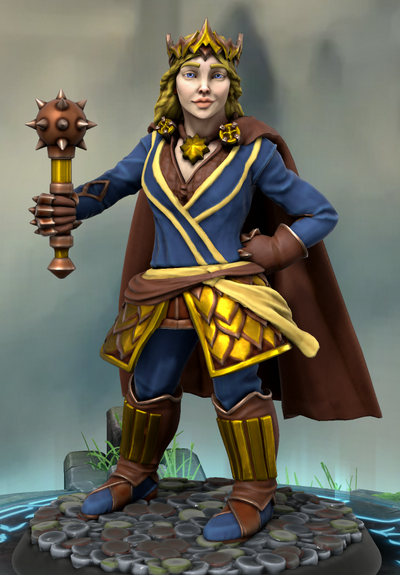
Queen Medb

Real Name: Medb Lethderg, First Appearance: Skybreaker Stories #183, July 1973

Lieutenant Type: Ally
Die Size: d10
Relation: Reluctant Ally, Approach: Magical

Traits:

  • Fight For Me: As an action, Medb may create a d6 “Royal Guard” minion, or Overcome to take control of an existing d6 or d8 minion. She may have up to two Royal Guards at a time.
  • Royal Aura: Medb has +1 to all action while near a Royal Guard.

After Dread Depths, a growing array of Celtic mythological figures appeared in Skybreaker Stories. Most of these were Fomorians and their minions, but the writers also included their own favorites from Cu Chulainn’s ancient tales. One of these, introduced to add yet another wrinkle to the ongoing romantic drama between Cooper and Rhonda Randall, was the ancient Queen Medb.

Medb Lethderg was an ancient demigod like Skybreaker, who was similarly placed into a mystical sleep with the defeat of the Fomorians. The rise of Atlantis woke her, and she emerged into the world to raise an army of heroes to fight against the Fomorians, using her superhuman charisma to cajole any capable-looking person into becoming one of her vassals. In her first appearance, Skybreaker was forced to intervene to save the hapless civilians she had convinced to be ‘heroes’ from the Fomorians she led them into battle against; she was in no real danger, and was delighted that her ancient friend/foe was alive in the mortal world, and Skybreaker had to sit her down and explain that she couldn’t just grab people and turn them into servants.

Medb didn’t see the problem. She was awakening heroic spirits, and it was for a good cause. But in order to stave off a spear through the heart, she agreed to dial back on the mind control. Over the next few years, she would appear repeatedly, having found some new scheme to build allies that was dubiously ethical and forced Skybreaker to intervene, but also legitimately helping him on many occasions. Her clear interest in the hero was not remotely reciprocated, but it was enough to create anxiety in Rhonda Randall. She saw a woman who was the brave, nigh-immortal warrior that could match Skybreaker, and it caused her to pull back from her own romantic aspirations, leading to soap opera drama between them.

Medb should have been a success – a selfish but heroic warrior demigod struggling to integrate into the modern world, prone to demanding fealty and putting others in harm’s way but steadfast in her opposition to Fomorian corruption. Unfortunately, her writing fumbled the ball. Most of her early appearances focused on Rhonda’s anxiety over her connection to Cooper, while also making it clear that Cooper had a complicated mixture of respect and annoyance with the brash queen. As a result, once that particular story beat was resolved in the late 1970s, Medb was shuffled off the page. She re-appeared briefly in the late 1980s, returning to attempt to throw a wrench in Cooper’s marriage while helping him deal with a Fomorian incursion, then vanished again. This would prove to be her modus operandi – occasionally a writer would give her a more complex backstory and start to set her up as an interesting supporting hero, and then someone else who only remembered her as ‘the warrior queen who causes romantic trouble for Skybreaker’ would undo the work and make the next writer start from scratch.

Behind the Scenes:

Every comics fan has that one character that they love when they’re done well, but also they are never done well, and that’s Queen Medb today! She ‘awakens the heroic spirit’ in random bystanders and makes them fight for her, and she’s probably got a whole section devoted to her in the Venture metaverse’s AO3, and every single one of them is a fixfic because she’s just awful as a character. No depth, not interesting, great idea totally wasted.

3 Likes

Wasted potential indeed. That “awakening the heroic spirit” thing is rife with possibilities. What happens if she uses it on a random criminal or villainous henchman? Do they suffer a lasting change of heart? There’s a story waiting there. If someone has latent powers, what are the odds that Medb accidentally awakens them with her meddling? Maybe those powers last on their own, or maybe they need regular “encouragement” from the Queen to remain active. That would be quite a complication for a newly-minted hero.

She’s a lot more interesting if it isn’t just run-of-the-mill mind control going on here. Saying what she’d doing is unethical when her “victims” are convinced they’ve had their eyes opened to their true potential raises some hard questions about free will and freedom of choice.

3 Likes

Yeah, I came dangerously close to creating a non-Deep Cut character halfway through the Medb process, and I had to make sure that she was actually a failed supporting character and not a really interesting addition to the Venture canon! I also wanted to make sure there was an open question about her abilities - if you use mundane charisma to convince people to be heroes and oppose injustice, but in the process you also throw them into situations way above their actual capabilities, what’s the morality in that?

By default, Medb’s abilities don’t give her Royal Guard much in the way of actual power or skill (hence why she only gets a d6 minion if she’s not stealing one) so she probably can’t awaken latent powers, unless they’re just waiting for a final push. Either way, if a player wanted to do the “let’s give another attempt at turning this D-Lister into a cool hero” approach in the Diamond Age, they definitely could, she’s semi-immortal!

2 Likes

Señor Libertad

Real Name: Javier De la Cruz, First Appearance: Madame Liberty #382, Oct 1973

Lieutenant Type: Ally
Die Size: d10
Relation: Close Friend, Approach: Technological

Traits:

  • Liberty’s Light: When Señor Libertad is facing enemies directly, he has +2 to Attack or Defend.

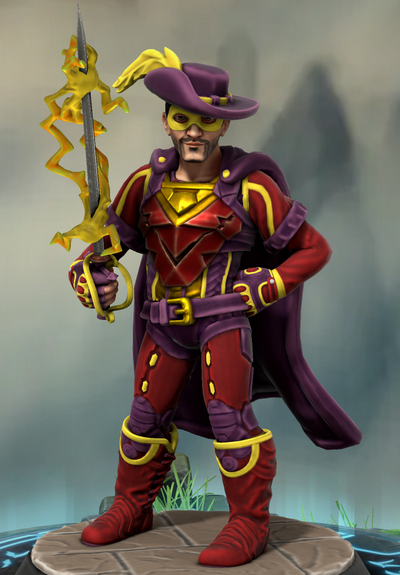
In the early 1970s, the writers of Madame Liberty began to see the first signs of the slipping sales that would ultimately cause the title to be merged into Liberty’s Dream. Looking for new inspirations to revitalize the heroine’s adventures, Alan Victor, the veteran lead writer at the time, drew inspiration from the still-running Madame Liberty animated television show. To introduce its third and final season, the show had just showcased an episode about the Liberty League, a one-time team-up of heroes from across Europe, and had made the at the time politically-risky decision to include a rather extravagant character named Señor Libertad, a Spanish swordsman in a power suit.

Victor loved the idea, and had a few thoughts on how to make it more politically relevant. At the time, Spain was still under the control of a fascist government, in a complicated position with the rest of Europe. He introduced the character of Javier De la Cruz, a Spanish super-technician and soldier who worked for the national government but was opposed to its ways. Imagining De la Cruz as a modern Zorro, he had him don a mask and sword as the mysterious Señor Libertad, inspired by his personal heroine, Madame Liberty, and wearing the colors of the fallen Spanish Republic as he battled evil. When White Mantis attempted to forge a political alliance with Spain, Madame Liberty and Señor Libertad worked together to reveal her plot and prevent her from selling weapons to the government. They parted as good friends, promising to call on each other when they were in need.

Victor envisioned the birth of a new Liberty League, with members joining from other nations under threat, and Señor Libertad would make a few more appearances. In the end, however, the hero was doomed by a triple disaster. The first was that the Champions editorial desk wasn’t interested in the sorts of radical politics Victor was pushing; their editor wanted traditional heroics, not an argument about the political status of Spain. He pushed back each time Victor tried to move the comic in a more political direction, wanting classic tales of spycraft against colorful Soviets. This in part led to the second disaster: Madame Liberty failed before Victor could follow through on more national heroes, and the newly-launched Liberty’s Dream Volume 2 simply wasn’t interested in national affairs. And of course, the third disaster for Señor Libertad was a boon for the world, with the death of Franco in 1975 and the country’s transition to a democracy. Under the new political climate, and the desire to paper over the sins of the past, a Spanish superhero whose existence was based on living a double life within an autocratic regime didn’t quite fit. Señor Libertad has continued to make minor appearances as the primary Spanish superhero through to the present day, but never made it to a major supporting role.

Behind the Scenes:

Madame Liberty had some weird things going on in the 70s.

This is one of those times the randomizer saved me. I wanted a Madame Liberty supporting character, but I had no idea what was going on in her final years. But a close friend, with a large enough die to be a superhero, and just some straightforward buffs? That’s easy - a new “Surname Liberty”! Making him Spanish and tying him to the failing Spanish fascist regime was a whim that I think worked out.

No real mechanical notes here. He’s big, he’s bigger if he’s not subtle, he punches bad guys. Señor Libertad is not that deep.

He is a great character to end on, though! Not forever, of course, I’ve got a ton left in the tank, but it’s time for an end of year vacation. I’ll be wandering online and offline for the next two weeks, so feel free to ask questions and I may or may not answer them. I’ll also be posting a couple of my Bronze Age deep cut revisions, and there’s a bit of a surprise lined up for Monday; we haven’t had anything huge, but there’s one portrait adjustment and a couple of fun bits I’d like to showcase on no particular schedule.

Our Deep Cuts will resume January 5th!

4 Likes

Happy holidays, Venturistas! Vacation continues, but I thought I would post a little something as a treat for the break. As I’ve been updating characters for the Deep Cuts book, the power of kitbashing allowed me to make a couple of alternations to one of my favourite holiday-appropriate characters. Here’s the new portrait for Icebreaker, the Christmas conqueror:

that reminds me- for the deep cuts will you include any short-term use but never forgotten alt costumes for existing heroes? It existed for less than one full issue but any video game that lets you unlock different Spider-Man costumes will have a Fantastic Four costume, a paper bag, and a kick me sign.

3 Likes

So, yes and no.

Space constraints mean that there won’t be anything that short-lived, but I’ve got a lot of short-lived variant runs of various heroes in the works. We sort of already got the first one, for Madame Liberty, but there are quite a few more in the pipeline over the Bronze and Iron ages. Those variants definitely come with their own alt costumes, but I’m not planning to include anything that isn’t tied to an equally short-lived storyline.

2 Likes

Howdy there, Friv! I’ve got a question for you. Sort of.

Essentially, I’m curious as to the reasons for the changes to the hero creation system that you included in Venture Comics: The Classic Years.

In particular, I’m curious as to…

  • Backgrounds:
    • Why you rearranged the order of the backgrounds and reassigned their numbers. I presume it’s to make their frequency of getting rolled more in line with how common you think they ought to be.
    • How you determined which power and quality dice each background gets. I presume that you had some balancing principle in mind, and were tying to make them all more balanced than the corebook does, but I’m curious about the specifics.
    • Why you changed some of the quality options, and how you chose which quality options to add/remove.
    • Why you changed some of the principle categories (I do recall you griping before about there being, I think, too many Responsibilities, so I presume that that may be at least partly responsible), and how you decided what new categories to use.
  • Other:
    • I’m wondering the same thing about the power source and personality dice that you changed as the background dice.

Beyond those points, I think I understand the rationales behind all the other changes, like altering the wording of some abilities or changing how retcons work.

If these questions require too long an answer, I’d completely understand if you don’t get to it. And if you have already explained all this someplace that I’m unaware of, feel free to point me there rather than going through it all again.

I’m asking all this because I’ll likely be starting an SCRPG campaign soon-ish, and I’ve been debating between using the core book’s default hero creation rules and using your revised rules. So, essentially, you could consider this a “Sell me on the Venture Comics hero creation rules” type thing.

Thanks!

1 Like

If you haven’t looked already, there might be some answers in the earliest posts on the slightly-older thread on RPG dot net over here. That one actually started in October of 2023, and while almost all of Friv’s posts are mirrored over here, the first few and the comments and questions diverge a fair bit.

1 Like

Hi!

Rich’s links should cover things, but I’m happy to summarize.

Backgrounds: As you guessed, I rearranged the Backgrounds to make the ones I feel are more common in my superhero settings be more commonly rolled. It was mainly a side benefit to the other sets.

The dice were a bit more straightforward - I started with the premise that each set should be ‘worth’ two d10s and three d8s, then created a few arrays by stepping dice up and down (with the extra principles that a step up from d10 to d12 cost two steps and a new d6 cost one step), and then made sure there were multiples of each array based on how weird they were. As a rough guide, I tried to give Backgrounds that felt more skill-focused higher qualities and Backgrounds that felt more power-focused higher Power Source dice, but the specifics were mostly vibes-based. Same thing for quality options - I tried to keep them in the same ballpark for how many things they gave access to, which meant nudging some up and some down.

The Principles were adjusted because yeah, they’re wildly uneven. In the core book, there are 14 Expertise options, 8 Esoteric, 7 Responsibility, 6 Ideals, and 4 Identity. I didn’t want to mess with Archetypes, so I messed with Backgrounds a lot to bring up the low zones and drop the higher ones. As a side benefit, it means that players are less likely to get duplicate Principles, because the Archetypes tilt one way and the Backgrounds tilt the other way.

For Power Source dice, I didn’t change much; there were just two dice spreads (d12, d6 and d10, d6, d6) that were weak enough I decided to give them each a step up. And for Personalities - there are two Personalities in the book that I feel are painfully weak, so I strengthened them a bit.

4 Likes

Siphon

Real Name: Agent Ted Larihue, First Appearance: Fallout #51, January 1976

Lieutenant Type: Enemy
Die Size: d6
Motive: Need, Approach: Raw Power

Traits:

  • Overcharge: If Siphon would be stepped down or destroyed and his status die is d8 or lower, step up his status die instead. If his status die is d10 or higher, roll it as a reaction and Attack all nearby targets with the result, then destroy him.
  • Radioactive Aura: When the scene tracker changes zones, step down Siphon’s status die, to a minimum of d6, then roll it and Hinder all nearby targets with the result.

As Fallout’s storylines escalated, Half-Life found himself dealing with enemies on both sides of the law. On the one hand, he was fighting against the 238 and their super-science minions, while also occasionally delving into extra-dimensional crime brought into Santa Juanita by longstanding enemies such as Gunrunner or Father Fathom. On the other side, he was on the run from law enforcement and from superheroes like Power Flower as he sought to clear his name.

Over the course of 1975, Half-Life’s situation came to the attention of federal law enforcement, and in Fallout #51 an FBI division was dispatched to Santa Juanita to support local police and bring this ‘super-powered menace’ to justice. They were led by Agent Ted Larihue, an anti-terrorism expert who believed that Half-Life was a nuclear monstrosity created by a terrorist attack; after his first encounter with Half-Life ended with Larihue unable to so much as touch him, he went looking for weapons that could stop the ‘monster’. This brought him in contact with Gunrunner, who happily sold him alien technology made to absorb nuclear power.

Armed with his new combat suit and taking on the name ‘Siphon’, Larihue confronted Half-Life, absorbing the hero’s blasts and growing stronger from them while Half-Life was struggling to fight Isotope and the 238. The battle ended with Larihue’s suit overloading, knocking him out. When he re-appeared a few months later in Fallout #54, it was revealed that the alien technology had affected him – his body had changed to require both radiation and dimensional energies, and without access to them he was slowly dying. Siphon came after Half-Life again, and was defeated again, but he was able to absorb enough energy to survive. He vowed to bring the hero to ‘justice’, and formed a task force to bring him down.

Siphon was a careful balancing act in the early years of the loosened Comics Code – a federal agent tricked into becoming a villain, slowly losing himself to his unstable technology. He was also introduced just as Half-Life started to interact with more heroes. When Half-Life joined Covert Tactics two years later, Siphon remained convinced that he was a villain, and went rogue to try and bring him down – but the Covert Tactics team weren’t that interested in him, and didn’t do much with the character. He would continue to appear periodically, including a minor appearance as a captive AEGIS villain in the 90s, but he never had the personality or goals to become a truly interesting character.

Behind the Scenes:

It’s always fun to have someone who’s a deep cut because they’re almost interesting, and here we are. Siphon draws on some of the “police officer pursuing rogue hero” tropes, and adds a bit of “dangerous overuse of alien tech” tropes, and then doesn’t actually have an interesting personality to back it up so he ends up not getting pulled up by writers that often and becomes a D-Lister.

Mechanically, this is a very funny build to me because if you just ignore him completely he’s not that dangerous, but all the usual tricks to instantly wipe small lieutenants make him stronger. You have to feed him power in the form of punching him for him to get strong enough to be a threat, and then you hit him too much and he explodes. You could probably include him with a villain who drops AOEs and have him get into the middle of one to tick up to d8 if the heroes don’t take the bait, though.

5 Likes

He’s probably best dealt with by simply Hindering him, although persistent Hinders are rare enough that you’d either need to keep burning actions to do so - or maybe take a minor twist to “buy” a two-use penalty on him if/when you roll well. Even a -2 makes him pretty worthless, and a -3 or -4 spoils his day something fierce.

I did something vaguely similar with the Moseby Twins back in - cripes mid-2023? Where does the time go? They’re more vulnerable in a lot of ways, though.

The irony of a d6 lieutenant’s approach being Raw Power is pretty amusing even with his abilities. :slight_smile:

It may not matter if this is meant to be the writers being lazy about accuracy, but (unlike the US military) the FBI doesn’t send “divisions” anywhere. Those are big, permanent administrative elements, just below the top-tier branches on their organizational chart. What you’re describing would most likely be designated as a task force or even just a field or liaison team. Either way, most likely to have a senior special agent (a mid-tier field agent rank) in charge.

2 Likes

Good point. That’s more me writing a thing without thinking too hard, it should absolutely be a task force. I’ll adjust that in the book.

1 Like

Poison Pen

Real Name: Penny Sterling, First Appearance: (as follower) Champions of Truth #136, August 1976

Lieutenant Type: Enemy
Die Size: d8
Motive: Malice, Approach: Mental

Traits:

  • Fake-Out: As a reaction to being Attacked or Hindered, Poison Pen can change places with a villain or environment minion anywhere in the scene, and redirect the Attack or Hinder to that minion.

As the Drifter shifted increasingly into less comedic roles in the aftermath of his Atlantean reveal and moved into Dark Rivers, his most prominent foes were left increasingly adrift, especially those whose themes didn’t fit the dark magic overtones of the comic. One of the most affected was Drifter’s primary nemesis, Poison Pen. Not only was her primary opponent taking part in more magical adventures but so was Madame Liberty, and the Vanguards were in a period of focus on interdimensional issues. This left her largely without a home, and she vanished from Venture entirely for a few years before an enterprising writer tossed her into a Champions of Truth storyline on a whim, accidentally coming close to consigning the character to fade away to nothing.

The storyline wasn’t a particularly notable one, although it was moderately popular. It was a classic Congress of Deceit storyline, in which White Mantis and Locksmith worked together to infiltrate the Champions in order to steal technology that was being held after being seized from various supervillains. The only major feature of the story was that White Mantis hired a few minor villains to distract the Champions, and one of them was Poison Pen. Rather than being the mastermind of the event, she was merely the hireling White Mantis used to infiltrate Champions Citadel; when she was cornered by Flatfoot in the base, she self-destructed and revealed that she was a robot duplicate luring Flatfoot into an ambush, and the real Poison Pen had hidden herself among White Mantis’s royal guard.

In the aftermath of the story, however, another writer was looking for minions for a Malefactor story and noticed Poison Pen. He tossed her onto the team in a similar role, using her duplicates to slip past Covert Tactics as part of one of Mr. Murk’s plots. From there, Poison Pen would flit across comics, appearing in various storylines roughly once or twice a year as a hired minion of the villain of the week, her own goals and methods largely reduced to “the smart one who has a couple of robot duplicates around”. A generation of readers grew up knowing Poison Pen as not a fiendishly capable engineer and genius infiltrator but a mercenary minion who was easily defeated but always slipped away to join another group.

Fortunately for Poison Pen, the Iron Age reboot of Venture brought her back to the fore as a major foe for Covert Tactics, and her temporary life as a low-grade mercenary was quickly forgotten. Readers would look back on her time as a hired spy for the Congress of Deceit and the Malefactors as an entertaining deep cut reminder that everyone makes mistakes.

Behind the Scenes:

There are two ways that established villains can have some real deep cut periods. One is when the villain acts wildly out of character for a while, and the other is when people just stop caring about them. Poison Pen has to deal with the latter problem here; she doesn’t have any big thing that goes wrong, she’s just accidentally shoved into a minor role and then stays there for almost a decade being overlooked.

This Poison Pen is a potentially awful person to deal with because of the redirects, but she can’t create minions so it’s pretty easy to manage her ability to retreat. Paired with a villain who spawns minions and/or an environment that does the same, she can be a real pain, constantly revealing yet another robot duplicate - but without those, she’s just a normal D8 lieutenant who won’t last long.

5 Likes

Alright , it’s time to get goofy with…

Mr. Infinity

Real Name: Reggie Zheng, First Appearance: (fractured) Vanguards #220, January 1977
Background: Military, Power Source: Shardborne, Archetype: Wild Card
Personality: Decisive, Principles: Speed, Mastery

Status Dice: Green d8, Yellow d8, Red d10. Health: 34 [Green 34-26, Yellow 25-13, Red 12-1]
Qualities: Finesse d10, Self-Discipline d8, Insight d6, Cosmic Fractures d8
Powers: Speed d12, Intangibility d10, Lightning Calculator d8, Momentum d8, Cosmic d6

Green Abilities:

  • Outrun Reality [ I ]: When you use an ability that includes a power die, you may take 1 damage to use a different power from the same category at the same die size, even if you don’t have that power.
  • Multitask [A]: Take any two different basic actions using Finesse, each using your Min die.
  • Surge of Effort [R]: After rolling your dice pool for the turn, you may take 1 irreducible damage to reroll your entire pool.
  • Principle of Speed [ I ]: When you successfully Overcome, you may end up anywhere in the current environment. You and each of your allies gain a hero point.
  • Principle of Mastery [A]: Overcome in a situation that uses your powers in a new way and use your Max die. You and each of your allies gain a hero point.

Yellow Abilities:

  • Cosmic Force [ I ]: At the start of your turn, if you have no bonuses, create a +1 “Cosmic Force” bonus for yourself.
  • Interrupt [R]: When you are Attacked at close range, Attack the attacking target by rolling your single Intangibility die.
  • Riddlemaster’s References [ I ]: Once per action scene, you may uncheck a checked off collection on your hero sheet.

Red Abilities

  • Too Fast [ I ]: Whenever you Attack a target with an action, you may also
    Hinder that target with your Min die.
  • Never Burn Out [ I ]: Once per issue, if you would go to 0 Health, roll Intangibility + Self-Discipline + Red zone die. Your Health becomes that number.

Out

  • Boost an ally by rolling your single Speed die.

In January 1977, at the culmination of another major attempt by the Empress of Ash to invade Earth and burn it to ash, the Riddlemaster intervened to support the Vanguards. The team’s persistent frenemy loaned a portion of their cosmic might to Mr. Infinity until he could solve ‘the riddle of my power’. With his speed charged to reality-shattering levels, Mr. Infinity was able to run between dimensions, grabbing the barriers that Amorta had damaged and tying them back together to bar her passage to Earth once again. At the end of the issue, he confidently told the Riddlemaster that he’d solved the riddle and saved the day, and the Riddlemaster told him that he was wrong and left without taking their powers back.

At first, this seemed to be all upsides to Reggie. With cosmic power flowing at his fingertips, he was able to perform incredible feats, running so fast that he could act with superhuman strength, twisting reality to catch strange energies in his place and manipulate temperatures and electricity, appearing in multiple places at once and even slowing the flow of time. He quickly became the Vanguards’ new powerhouse, showing off his skills and easily defeating villains.

Percy Fern, the Vanguards’ writer at the time, had hoped to use the storyline to move Mr. Infinity to a cosmic hero role that he felt Venture Comics was lacking. His plan was for Mr. Infinity’s powers to continue to grow, and for him to ultimately become a solo hero and be replaced by Half-Life, closing that circle. But he received editorial pushback. Half-Life was on his way towards joining the new Earthwatch title under development, and the feeling in the bullpen was that the Vanguards had already been shuffled too often.

With his original plan denied, Fern quickly pivoted to a new approach and pretended he’d always been planning it. During a routine confrontation with the Malefactors in late 1978, Reggie accidentally ran too fast, slipping through dimensional barriers and finding himself in a technicolour dimension that was so beautiful that it twisted his perception of time; he returned to find that the fight had been over for an hour and Captain Bolt had been badly hurt. He started to find himself running even when he didn’t mean to, accelerating to lightspeed when he meant to walk to the fridge for snacks. The power burning within him was too much; his mind couldn’t focus on it, he couldn’t grasp the rules that it operated by.

Over the next year, Reggie’s problems very slowly grew more intense; eventually, Captain Bolt called in Dr. Cosmos to help. She told Reggie that his efforts to master his abilities were technically working, but aligning himself with a cosmic awareness at the level he was aiming for was causing him to lose himself. He would have to make a choice – master his powers and lose himself, or find a way to get rid of them for good.

Vanguards #250, released in July 1977, delved into this dilemma, with readers unsure which way Mr. Infinity would go. But at the end of the issue, Reggie went to the Riddlemaster, and told the cosmic godling that he had finally solved their riddle. Power didn’t offer freedom – it only changed how you were bound, and he wanted to be bound by mortality, not godhood. The Riddlemaster applauded, and took back the power that they’d given him, restoring him to his previous superheroic self. They asked only that he remember that answer in their future encounters, and sent him back to Earth with a promise that they would continue to ‘help when they could’. The comic ended with the Riddlemaster sitting alone in their cosmic realm, watching the stars and reflecting on how they were glad for Reggie’s freedom, but envied him all the same.

Behind the Scenes

So, a while back there was a discussion on the Sentinels discord about the most and fewest action abilities you could get access to, and I started wondering about what the fewest action abilities you could have and still be viable was. After some back of the napkin math, I determined that you could do it with Artificial Being / Physical Powerhouse and be very good at a single thing, tanking blows, or you could do it with Shardborne / Wild Card and be kind of okay at everything.

You can see which direction I went.

This is the only Shardborne character I plan to do for this campaign; my version uses d12 / d6 / d6 instead of d12 / d4 / d4, but otherwise I’ve just cleaned up some language for how I think Amorphous Power is meant to be used. It’s really muddy wording, with interpretations that make it anywhere from staggeringly OP to completely useless; I’ve tried to find a middle ground. For Mr. Infinity, this means that he can really only use Amorphous Power with his Principle of Mastery, his Multitask, and his Interrupt, but that is a real powerful set of three abilities to use, especially with a d12 Athletic, a d10 Self-Control, and d8s for Intellect and Mobility.

I’ve also made a minor adjustment - rather than having “Break the 4th” be a reaction that can be triggered each turn, it’s an Inherent that can be triggered once per scene. This is because “Break the 4th” is completely broken, but reducing it to once a scene felt like it needed a minor buff. I think an inherent that gives you a free non-reaction collection use once is about right.

Narratively, this is one of those fun “the writer started a story, was told he couldn’t do that story, pivoted the story, and it wound up being a very well-received story that didn’t have a lot of long-term impact” situations. It also gives us a different Mr. Infinity costume. Everyone in the 70s had weird V-necks, they were everywhere, and this was my best imitation.

And I think that’s the only thing worth mentioning here, surely.

5 Likes

Lol, “outrun reality” is so great in a dumb way that’s wonderful.

3 Likes

That change doesn’t seem to be in effect here:

Can’t argue that point. It makes me suspect that little, if any, playtesting lasted long enough to earn even a single collection, despite six sessions being a pretty small ask.

Personally, I’ve been homebrewing 4th Wall as a once-per-action scene reaction all along, and I still think it may merit a further nerf to once-per-issue/session. If Purity is so game-changing it’s a once/scene and Resurrection is once/issue, a de facto free collection every scene still doesn’t feel reasonably balanced to me. Sure, it’s dead ability until your first collection comes in, but you get a character rewrite to alter abilities at the same point so there’s never a real drawback there.

2 Likes