Doesn’t character creation give everyone an automatic collection for their origin story?
Ahh, you’re correct. I wrote up the character initially to use it as a reaction along with Push Your Limits so that he could trigger it every turn and also get rerolls and counterattacks, decided that was brokenly silly, revised it in the book and forgot to revise it in my online copy. Fixed now, along with the revised Red ability since he’s not as reaction-focused.
It doesn’t! That’s an optional rule farther in the book. All of the sample characters have one collection, and the starter set characters have one collection, but by default you start with none.
3 Likes
Are we supposed to know who Riddlemaster is? I searched the thread and didn’t see a prior mention of them.
2 Likes
It’s a riddle!
In all seriousness: No, you aren’t supposed to know who this is, although this entry certainly contains some sizable hints about the Riddlemaster and their whole deal. I designed them for an upcoming supplement, but when I was working on this variant they fit much too perfectly so I tossed them in as a teaser.
The very short version until more information becomes known: The Riddlemaster operates in something of a middle ground between Q and Bat-Mite, and is a persistent friend and foe of both the Vanguards and the Celestial Travellers.
6 Likes
I like that riddle answer too 
3 Likes
Yeah, it’s a thoughtful one for sure.
From what little we know of him, Riddlemaster reminds me of the Beyonder from the Moon Girl & Devil Dinosaur cartoon. Which is high praise, given that he’s one of the best supporting(?) characters on the show.
Also inevitably reminds me of McKillip’s old fantasy novel trilogy, although the Riddle-Master of Hed is hyphenated like Peter-Parker’s alter-ego. That’s high praise too. Neat setting and engaging characters in that old set of books.
1 Like
Is that a different Beyonder from the one that did the original Cosmic Contest Secret Wars?
That is high praise, and it’s definitely among the inspirations. Beyonder (especially in Season 2) was a great part of that show.
Loosely inspired by, but definitely extremely different in application.
Yeah, as good as he was prior to that, once the whole family knows about Lunella’s Moon Girl gig and he can interact with them directly things got even better.
Also that second Molecule Man episode Grandpa references in your linked vid made my icy dead heart warm up so much I can’t even make a reindeer fly any more, much less transform a child-hating burgermeister into a flash-frozen corpse. They should put a damn warning label on that show: Danger! May Induce Empathy Toward Others!
How do you do an episode of gloriously frenetic fight scenes and still have the hero unequivocally win by showing some understanding and forgiveness?
1 Like
Reverie
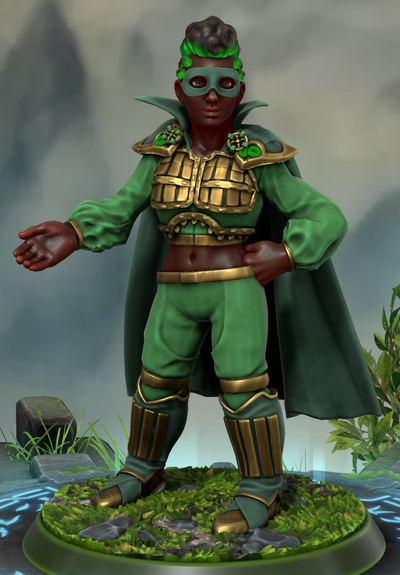
Real Name: Charlotte Williams, First Appearance: (faeborn) Liberty’s Dream (Vol. 2) #67, March 1981
Background: Otherworldly, Power Source: Supernatural, Archetype: Sorcerer
Personality: Arrogant, Principles: Principle of Reckoning, Principle of the Inner Demon
Status Dice: Green d10, Yellow d8, Red d8. Health: 30 [Green 30-23, Yellow 22-12, Red 11-1]
Qualities: Alertness d10, Persuasion d10, Otherworldly Mythos d8, Fitness d6, Half-Fae d8
Powers: Radiant d12, Intuition d10, Teleportation d10, Illusion d6, Vitality d6
Green Abilities:
- Baleful Portal [A]: Hinder using Teleportation. Use your Max die. If you roll doubles, also Attack using your Mid die.
- Tendrils of the Underhill [A]: Attack multiple targets using Radiant, using your Min die against each.
- Principle of Reckoning [A]: Overcome when you are repaying a favour or avenging a slight and use your Max die. You and each of your allies gain a hero point.
- Principle of the Inner Demon [A]: Tap into your fae psyche to Overcome a problem and use your Max die. You and each of your allies gain a hero point.
Yellow Abilities:
- Fae Form [A]: Boost yourself using Radiant. Use your Max die. That bonus is persistent and exclusive.
- Wisps of Dream and Nightmare [A]: Boost or Hinder using Illusions, and apply that mod to multiple close targets.
- Break The Bargain [A]: Destroy all bonuses and penalties on a target. Then, Hinder that target using Radiant, using your Max die.
Red Abilities
- Instant Karma [A]: Attack using Radiant and at least one bonus. Use your Max+Mid+Min dice. Destroy all of your bonuses, adding each of them to this Attack first, even if they are exclusive.
- Evade Consequences [R]: You may take 1 irreducible damage to reroll the dice pool of a target that is Attacking or Hindering you.
Out
- Hinder an opponent by rolling your single Radiant die.
In mid-1980, Shannon Pace finished her critically-acclaimed but financially wobbly run on Liberty’s Dream Volume 2 after sixty issues, handing the story off to relative newcomer Jordan Marks. While Liberty’s Dream had a strong core of supporters, its actual sales had been slowly slipping for the past three years, and H.R. Randall wanted something that would shake things up. Marks was an eager and enthusiastic young writer who had distinguished himself in a Hidden Champions story the year before that featured Reverie and Wonderer joining Corporal Liberty and Neutrino to fight Spriggan and Lord Trake, and Randall thought that the story had perfectly balanced the competing needs of the Mystical and Champions desks. He assigned Marks the task of building a new status quo for Liberty’s Dream that could function both in cerebral mystical stories and in pulpier Champions of Truth titles.
After taking a few issues to find his feet and reassure fans, Marks set things off in Liberty’s Dream #67, revealing that Reverie’s father, long referenced as a businessman who had died in an accident when Charlotte was a teenager, was actually a minor fae lord who had met and fallen in love with her mother, bargaining for a life as a mortal in order to live with her only to die at the hands of jealous fae rivals who took advantage of his mortality to engineer an ‘accident’. When Robin Goodfellow tried to give her powers as a result of their pact, he accidentally woke Reverie’s fae heritage, which was why she was such a powerful wielder of fae magics.
With her heritage discovered, Reverie began to practice her magical gifts more fluidly, discovering that she could draw on her fae heritage to make pacts of her own, empowering the actions of her friends and punishing her enemies directly for their deceits and broken promises. In the process, however, she began to become more alien, more prone to believing that her bargains were law and that she always knew the correct path. She pushed back against her friends when they worried about her, convinced that they were worried for nothing and that she had the power that she needed to succeed.
Marks hoped that a half-fae Reverie would let him explore fae issues more in-depth, while also having a more mercurial member of the Champions of Truth that other writers would enjoy playing with; her enhanced magic was nebulously restricted in the way of many fae powers, keeping her from being a solution to every problem while letting her go toe to toe with major threats. Readers were less happy with the direction, however. It turned out that what people loved about Reverie was that she was an ordinary woman who had chosen to be a hero, taking on power and responsibility to fight injustice. Many readers speculated that the new direction must be some sort of fae trick, and that Reverie would have to see through it soon.
If there was one thing that Marks had going for him as a writer, it was an ability to adapt on the fly. Seeing the public reaction to Reverie, he quickly began to sprinkle hints into comics that supported one theory or another, and he carefully read the letters pages every month and adjusted storylines on the fly to guide the comic in the direction fans were expecting. It drove his artist to distraction, but it worked. When Liberty’s Dream #90 ‘revealed’ that Spriggan had planted all of the information about Reverie’s father in order to try and trick her into breaking her own oaths, and had been feeding her fae power to manipulate her, fans were delighted. Marks didn’t reveal the prestige until an interview twenty years later, laughing about how close his first writing job had come to being his last. The success of his gamble led to him taking on the role of lead writer for Champions of Truth in 1985, leading to a long career at Venture Comics.
Behind the Scenes
Sometimes I write similar things back to back, and they’re too good for me to junk either of them so it just becomes a funny coincidence. In this case, we get two different 1970s heroes who get power upgrades that leave them at odds with their teammates, and who then have to lose those powers to get back to the status quo because the writer’s initial goals don’t work out, and also the storyline involves the mention of a major antagonist that I haven’t touched on before. That’s fine by me.
Faeborn Reverie is definitely one of those things that you’d see in the 70s and 80s: “Oh, this hero has a secret backstory that no one knew about, aren’t they so much cooler now? No? Really? Oh. Okay, the secret backstory wasn’t real.” I have a soft spot for that sort of retcon, so Venture gets one of its own! And kudos to an author who rolls with the punches instead of doubling down on their fave.
I don’t think there’s a lot to say about Faeborn Reverie mechanically. She’s got a decent spread of Attacks, Boosts, and Hinders but with Hinders as her focus, she has a couple nice tricks up her sleeve, she’s a little fragile but has some tricks in Red to keep herself alive. Just a generally versatile character.
As for Spriggan, he’s sort of Reverie’s secondary nemesis. He’s one of the primary dark fae creating deals with powerful assholes so that he can revel in the chaos caused, he joins up with the Congress of Deceit in the late 60s, and he’ll get a full writeup some day.
6 Likes
I’ve only caught snippets of this enormity so far, but it seems as though you’re doing a much darker and more malevolent Fey Court than the one that premiered in DERCR, which is a neat contrast.
Much broader and more variable, definitely.
They Fey Court in Sentinel Comics is sort of a neutral force that can be chaotically dangerous, but they’re largely under the control of the Dagda and the Morrigan. I think C&A implied that there are other fey courts with their own rulers, but they’re always individual groups of trouble-makers.
The fae in Venture, on the other hand, each belong to sets of rival Courts, with most fae belonging to anywhere from two to four courts at a time. Every set of courts has its own internal politics and enemies, so a lot of fae are simultaneously allies and enemies to each other, and they’ve all got their own passions and goals. So there are fae much more benevolent and kind that the Sentinel Comics ones, who you can rely on as long as you are fair with them, and there are also fae who are straight-up mass murderers who feed on fear and violence.
For example, Reverie’s ally Robin Goodfellow is a member of the Seelie Court, but also a member of the Summer Court, the Court of Stars, and the Court of Air. Reverie’s nemesis Spriggan is a member of the Unseelie Court, and also a member of the Autumn Court, the Court of the Moon, and the Court of Air. So most of the time Robin and Spriggan are political enemies and hate each other, but then the Court of Fire comes muscling into town and they join forces to throw those losers back to the Underhill.
Reverie’s thing, basically, is that she was empowered by benevolent fae as a proxy to fight against people empowered by malicious fae, and she’s really good at it so she ends up with some of those malicious fae as nemeses because they’re mad at her for ending their fun and games early.
5 Likes
Sounds like in this universe, allegiance to a given court is sort of like having one of Kaargra’s Titles, if she routinely gave the same title to more than one character, and then scheduled all brarers of one title to fight all bearers of another title. Which is absolutely the kind of thing KW would do.
this is one of the many places where we can invent Venture writers and Sentinels writers influencing each other.
Venture had “fey court” quite early, so Sentinels waited a while to use the same public domain legends.
Venture’s court was very Shakespearian with whimsy, malice, and capriciousness in equal measure a constant story contrivance.
So, Sentinels kept them mostly the Celtic pantheon with only some colorful characters, mostly grim with only an occasional revelry, but also isolated and not dealing with humans as a common game
4 Likes
Eddie Lockhorn
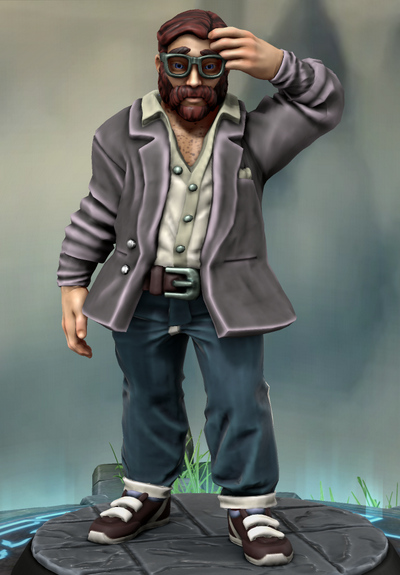
Alias: Edward Lockhorn, First Appearance: Earthwatch #48, February 1983
Lieutenant Type: Ally
Die Size: d8
Relation: Professional Contact, Approach: Mental
Traits:
- Mistakes are Opportunities: When a nearby ally takes a minor twist, Eddie may use his reaction to have a nearby enemy also take a minor twist. If he does, he also Hinders both himself and that enemy using his sole status die.
In 1983, Charles Morris began to write an Earthwatch storyline in which the U.S. government became increasingly nervous about a major superhero team made up of interstellar criminals operating on its soil without permission. While the Steward was a respected hero, he was also a foreign agent, and it was decided that the State Department should send an ‘ambassador’ to formally support and informally spy on the team. No one wanted the job, because no one wanted to be an unpowered human spying on a group of aliens led by one of the world’s foremost heroes, so the State Department sent Edward Lockhorn.
Eddie was a good-natured, vaguely baffled man who was brilliant but not particularly diplomatic. He’d been a political analyst who found himself in a dead-end job after his insightful reports contradicted more popular State department plans, embarrassing his superiors; throwing him to Earthwatch was both a way for him to be useful and a way for his immediate supervisors to keep him out of eyesight of the people he’d annoyed. Morris’s artist drew Lockhorn to look like Morris as a joke, and Morris leaned into it with occasional jabs about nonsensical plot points and Lockhorn feeling completely overwhelmed by the team he was theoretically looking after.
Over the next two years, Lockhorn would generally be supportive of Earthwatch; while his own bosses wanted him to spy, he fell into doing his actual job and helping instead. He was quick to spot opportunities for the team, and in a few issues he even turned possible disasters into major successes by advising the team on ways to use a situation to their advantage.
Following the end of the “Sovereign of Secrets” storyline, Morris left Earthwatch and took a few years away from Venture to work on independent projects. He was replaced by Fiona Terrace, who was put in charge of guiding the team into the new Iron Age status quo. In February of 1985, exactly two years after his introduction, Synthesis brusquely informed Eddie that as Earthwatch was moving out of American territory, they no longer required a political liaison and he could return to his offices. As the shocked man began to leave, downtrodden, Hyperstar stopped him and flew him up to the Earthwatch roof, where the rest of the team had arranged a goodbye barbeque in his honor. They told him that wherever he went, he would also be a part of the Earthwatch family.
Eddie showed up a few times throughout the Iron Age, and it was implied that he’d stayed in touch with the time, but didn’t make another major appearance. Despite this, the character’s warm send-off touched the legendarily prickly Morris, who wrote to Terrace to thank her. The two established a friendship, and when Morris took over Celestial Travels a few years later he was quick to approach her to be his collaborator on what became the “Peacekeepers” event.
Behind the Scenes:
A lot of folks were getting government handlers in the late 70s and early 80s, and this is the Earthwatch one! He exists in part to build up a bit of metaverse fun with the friendship between the first and second Earthwatch writers, but I like how he turned out. I almost had Morris spitefully have his own author insert get murdered by the Sovereign, but I liked the heartwarming ending more.
5 Likes
Given the way NPCs take twists, forcing minors on them will wind up with some very different results than you get with heroes. Actual villains will probably opt to pass the consequences off to their minions/lieutenants whenever they make it fit narratively.
1 Like
Yeah, that’s deliberate. Villain minor twists are enough bigger than hero ones that it’s a pretty powerful reaction, and it kind of encourages the heroes to get sloppy and create more narrative problems for themselves when Eddie is around in order to force the villain to make rough choices. If the villain can just sacrifice a minion to it, that’s pretty good.
1 Like
Even with lieutenants it’s quite powerful. Knocks them down a size automatically and saddles them with a modest penalty to boot, which could easily wind up applying to a save. Good way to start the death spiral going on a tough d10 or d12 that the pCs might normally struggle to soften up initially.
1 Like
The Rustler
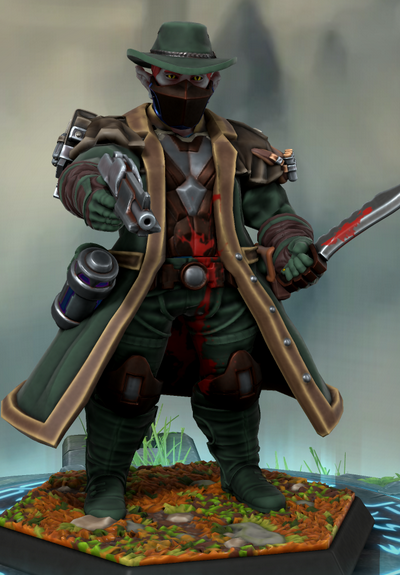
Real Name: Zorus Z’Graf, First Appearance: (murderous) Earthwatch #103, October 1987
Approach: Mastermind, Archetype: Predator
Upgrade: Villainous Vehicle, Mastery: Superiority
Status Dice: 0-1 engaged opponents: d10. 2-3 engaged opponents: d8. 4+ engaged opponents: d6. Health: 35+5H
Qualities: Stealth d10, Technology d8, Deep Space Knowledge d8, Close Combat d8, Imposing d8, Hunter d8
Powers: Gadgets d12, Invisibility d10, Awareness d8
Abilities:
- Sight Your Prey [A]: Boost yourself using Hunter and use your Max die. Either make that bonus persistent and exclusive, or Boost yourself again using your Mid+Min dice.
- Make It Flashy [A]: Attack one hero using Technology. Hinder all heroes using your Max die.
- Make It Hurt [A]: Attack using Stealth. Use your Max die. If the target has a penalty you created or is in the Red zone, use your Max+Mid dice instead.
- Quick Draw [R]: When Attacked, roll your single status die. Hinder the Attack using that result, and deal damage to the attack equal to that penalty.
- Diversion Drone (I): The Diversion Drone is a d10 lieutenant with the following abilities:
- Sonic Barrage: When this vehicle uses a Hinder action on its turn, roll twice and use the higher result.
- Space Metals: When rolling a damage save, add 2 to the result.
- Set Traps [A]: Create two d6 Autonomous Traps.
Common Scene Elements:
- Autonomous Traps: d6 minions. When an Autonomous Trap Attacks, roll their status die twice and combine the results. Attack and Hinder a target with that result and then remove the Autonomous Trap.
- Hunting Grounds: A semi-urban environment that creates environment targets for the Rustler to go after, and challenges and Hinders related to the traps he set to separate and confuse the heroes.
As Earthwatch built towards the Peacekeeper invasion, one of Fiona Terrace’s major goals in order to create sympathy for Synthesis and her terrible decision to support Peacemonger was to show the ways in which the galaxy was growing more dangerous in the aftermath of Xur’Tan’s fall, and the ways in which Earth had been left more vulnerable. This meant that throughout 1987 and 1988, a growing percentage of Earthwatch’s foes were aliens who were seeking to exploit the planet or its people, often in increasingly deadly ways. While many of these foes were new creations, Terrace also pulled in a handful of older menaces, making them even more ferocious and deadly. One of these was the bounty hunter known as the Rustler.
The Rustler had always been a professional, acting on the boundaries of civilization, but free from the threat of interstellar justice he began to accept far more violent and cruel jobs. In his first Iron Age appearance in Earthwatch #103, he was hired to gather human organs for experimentation, hunting for top-tier specimans rather than simply grabbing random people. Earthwatch discovered his activities after he had already killed an Olympic gymnast and a US sniper, and were able to prevent him from completing his list, but two more innocents died when he used autonomous robotic traps to force the team to save lives instead of apprehending him.
This much more vicious and cruel Rustler would return again in 1988, targeting humans who had been touched by interdimensional energies and killing anyone who got in his way. This time, Earthwatch was able to apprehend him, destroying his ship and stranding him on Earth before handing him over to AEGIS, but when they learned that he had easily slipped out of custody a few issues later Synthesis became convinced that Earth wasn’t equipped to handle alien enemies. It was one of the key events leading to her decision to give Peacemonger her formulas, with tragic results.
With the end of Earthwatch, the now Earth-bound Rustler hopped between comics for a few years, making appearances in Champions of Truth in 1990, as one of the alien enemies of Vanguards of Order in 1991, and in a pair of appearances in Remnants in 1992 and 1993. His methodology remained fairly constant, even if he was working for human patrons instead of alien ones – target a person or technology for theft or destruction, use death and destruction to distract foes away, and then strike. He was frequently portrayed as enjoying the harm that he caused, even if it was still a means to an end and not his purpose, and each appearance ramped up his kill count a little bit more.
After the speculator market collapse, however, the Rustler vanished for a few years. When he eventually re-appeared in Stargazers in 1998, he once again had a spaceship and was working for alien groups, and he had returned to his original methodology of limited violence, an easygoing attitude towards victory or defeat, and a focus on the paycheque over the hunt. Stargazer’s second writer, Oleandra Smith, had always enjoyed the previous Rustler, and she took the opportunity to deliberately erase his murderous period and fix him back in what she felt was his proper attitude. Much later, the Plutonium Age Stargazers run would retcon the events of the early 1990s by explaining that the Rustler had been going through a very bad breakup and felt kind of embarrassed about the whole thing.
Behind the Scenes
Everybody got kind of murdery in the Iron Age, and it felt like the guy who was introduced as “alien poacher” absolutely got the Predator treatment from writers who thought it would make him more of a badass. What it did instead was make him more generic, so when someone decided to ‘fix’ him back to his first version there wasn’t any pushback. Rustler definitely vanishes for five years in part because he’s not quite big enough to be a major part of the speculator collapse, and because the main alien storyline at the time is about aliens not being murderous hunters here to steal your children.
6 Likes
Somehow that actually makes the ultra-violent 90s version even worse for me. Resorting to casual murder because you can’t deal with your relationship problems is certainly childish 90s trash writing, I’ll give it that.
Interesting variation on the usual Villainous Vehicle minion deployment trick. I assume to more limited number created is to balance out the relatively high strength of the Trap minions themselves - those things are better than some d12 minions would be on offense, and being very short-lived isn’t much of a drawback with d6 minions anyway. They fall over to a stiff breeze already, after all.
2 Likes